Showing posts with label Disability Rights. Show all posts

March 1, 2018

Banners of the UK Disabled People’s Movement

By Gill Crawshaw

In 2016 I organised a disability arts project in Leeds, UK called Shoddy. The project centred on an exhibition of textile-based work by disabled artists and was a showcase for some fantastic artwork. The exhibition had a few themes, including protesting the government’s “shoddy” treatment of disabled people, with huge cuts to welfare benefits and other public funding that are disproportionately affecting disabled people. 
Shoddy is the name for new cloth created from woollen waste and recycled fabric. This original meaning is now largely unknown, and the word has come to mean of inferior quality, shabby, broken-down. Through this project, disabled artists challenged those assumptions that our work, and our-selves, are inferior, broken-down, second-rate or badly made.
Recognising the origins of shoddy, the project considered a number of issues and events that linked disabled people to textiles and cloth. As a member of DAN – the disabled people’s direct action network – in the 90s, I remembered how important our banners were in stating our case clearly and in instilling pride in activists. With this in mind, I pulled together some information about banners I was aware of that had been used in support of disability rights, which was published on the Shoddy blog. Here’s an updated version of the original article:

***********************************************

Political banners, with their traditions reaching back through the labour movement, have something in common with the Shoddy exhibition. Being fabric-based is the obvious connection, with a skilful use of embroidery, appliqué and painting to convey a strong message. Banners usually carry a message of protest or resistance, but are as often about identity, pride, unity and justice.

DAN banner on the right, the only photo I can find of it. Photo: Tony Baldwinson
DAN banner on the right, the only photo I can find of it.
Photo: Tony Baldwinson

We are familiar with trade union banners, the banners of the women’s suffrage movement and, of course, banners that are carried on demonstrations –  sometimes quickly and roughly made, but with something to say and aiming to grab your attention.
The UK disabled people’s movement has created some wonderful, attention-grabbing banners over the years, including the legendary banner that accompanied DAN, the disabled people’s direct action network, on actions during the 1990s. The slogan “to boldly go where everyone else has gone before” was the backdrop for DAN’s campaign for accessible public transport when activists boldly handcuffed themselves to buses and trains and stopped traffic for hours.

Banners have carried the messages of the disabled people’s movement since it began. “Not Charity But Social Justice” and “Justice Not Charity” appeared on banners carried by the National League of the Blind in 1920, demanding legislation to protect their rights and guarantee a minimum income for blind workers.

Slogan: People against cuts

This slogan echoes down the years. It’s one of the foundations of the disabled people’s movement. DAN was formed after the Block Telethon demos of 1990 and 1992 demanded “Rights Not Charity”. DPAC (Disabled People Against Cuts) makes the same demand today, evidenced in their banner in 2015’s Art, Life, Activism exhibition at the Attenborough Centre, Leicester, which showed art informed by the politics of disability.

Picture: National Legeau of the blind and disabled

In the same exhibition, there was a later example of a banner from the National League of the Blind & Disabled, as the organisation later became.
Other UK disabled people’s organisations who have made banners for marches and demos include WinVisible, Mental Health Resistance Network and Black Triangle.

quilt made by supporters of the campaign

Not strictly a banner, the quilt made by supporters of the campaign seeking Justice for LB (“Laughing Boy”) or Connor Sparrowhawk needs mentioning. Connor died in 2013, aged 18, while a temporary patient in a specialist NHS treatment and assessment unit for people with learning disabilities in Oxford. He drowned in a bath following an epileptic seizure. An independent inquiry found that his death had been ‘preventable’ and the inquest in October 2015 concluded that neglect was a contributory factor in his death. The campaign seeks both justice and changes in the hospital system to prevent this happening again.
The quilt was made as part of 107 days of action taken by campaign supporters in 2014 and is a celebration of the life of LB. 
In 2015, to celebrate 800 years of Magna Carta, Parliament commissioned nine artists, three of whom are disabled, to produce banners for Westminster Hall. Jason Wilsher-Mills created banners inspired by the 1834 Tolpuddle Martyrs and the 1995 Disability Discrimination Act (DDA).
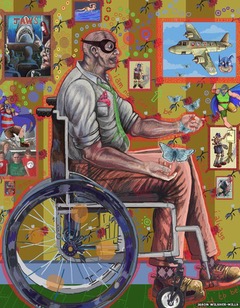
Jason Wilsher-Mills parliament banner.

Rachel Gadsden took the 1601 Poor Law and the 1829 Catholic Emancipation Act as her inspirations. Paula Stevens-Hoare marked The Great Reform Act of 1832, which extended the right to vote, and the 1967 Sexual Offences Act, which decriminalised homosexuality, with her banners.
The banners have now been gifted to different venues round the country. Jason Wilsher-Mill’s banner will be exhibited at The Art House in Wakefield later this year.
The final example of a powerful and moving banner that’s both protest and remembrance is the one created by Gill Thompson and Maggie Zolobajluk listing the names of people who have died due to benefit cuts and sanctions. Gill’s brother was David Clapson, an ex-soldier who died penniless and hungry following benefit sanctions (see short video). The banner was taken to the Government’s Dept for Work & Pensions headquarters earlier this year, along with a petition signed by 31,000 people, demanding changes to the sanctions policy. So far none have been made and the DWP continues to abdicate all responsibility for David and others’ deaths.

The work of one of the artists who featured in the Shoddy exhibition, Lesley Illingworth’s Story Telling Coat likewise remembers those who have died due to benefit cuts, pairing names of the deceased with Members of Parliament and warning that this is the ultimate price demanded from disabled people who are unable to comply with punishing work regimes.
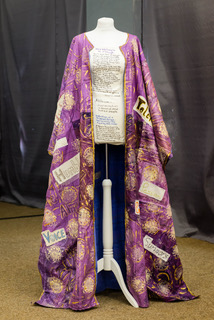
Storytelling Coat by Lesley Illingworth. Photo: Mat Dale.
Storytelling Coat by Lesley Illingworth.
Photo: Mat Dale.

Recommended Citation:
Gill Crawshaw (2018): Banners of the UK Disabled People´s Movement. In: Public Disability History 3 (2018) 3.

May 25, 2017

“I guess I’m in between” A conversation with my mother about disability.

by Ylva Söderfeldt

“Disabilities? I don’t have any!” This is my mother making a joke when I asked her if I could interview her for the blog. She’s visiting from Sweden to hang out with her grandkids (and me), something she does often as she’s mostly retired from her work as a neurologist. My mother is a professor of neurology, holds an M.D. and a Ph. D., and still practices medicine sometimes. She has four children and seven grandchildren. Born in 1946, she belongs to the post-war generation and although she was quite busy raising children and building a career, she has also been a life-long activist. She is also hearing impaired since birth and now has a cochlear implant. I’m her youngest child, now a historian, and have focused on Deaf history for most of my career, a topic I got acquainted with through her. I wanted to talk with her about the many ways in which disability figures in our lives.

The thought I had was to have a conversation with you about disability from different perspectives.

Do you mean hearing impairments?

Yes, that would be one thing we could talk about. And there are different dimensions to that too, professional, personal…


Well, I realized at a very early age that I had reduced hearing. But to be honest, although I realized that there are many things I just can’t do, like singing, I never thought that it was a real obstacle. I just didn’t have that perspective. I think many others think like that: “I can’t do this because I’ve got this thing”. But I never thought that. Maybe because I did very well in school. I was better than the hearing kids! So maybe that immunized me from thinking that hearing is superior.

You mean you didn’t see it as a problem?

Yes I did see it as a problem. But I never thought that I couldn’t do the things I wanted. OK, I can’t do everything, I was never going to be a ballet dancer for instance, but those are all things I never wanted to do anyway. What I wanted to do, I could do. But it was harder for me than for others, that’s something I’ve realized now that I didn’t before. I had to work harder than other people.

I think everyone else realized that. I know we talk about it, among the siblings. “How did she do it?”

Yes, I realize now looking back that a lot was tough.

When I was little, you had hearing aids, and it’s a favorite anecdote of mine how I used to think I’d get them too when I got older, just like I’d get other things I associated with an adult woman: hearing aids, nail polish, heels… But you didn’t have hearing aids growing up.

No. And that’s a funny story because many disabled kids think their disabilities are going to go away when they grow up. But for you, it was the other way around. Anyway, I’ll tell you: I grew up in the administrative region that belonged to Örebro, and in the 1950’s, they were the most advanced in Sweden when it came to hearing impairments. They had a deaf school there that was very oral-focused, and the kids there were the ones with the most residual hearing, or who were deafened late. So maybe because of that, they were prominent and very modern in audiology, and there was a training facility. I lived in a small town so I didn’t have regular access to this, but I got sent to a summer school for hearing impaired children. I didn’t feel very at home there, I must say. But it made me aware of that Deaf people existed. Some were more deaf. We definitely didn’t sign or anything but a couple of the kids knew Sign Language. So I learned that it existed.
But I still thought, for a long time, that I was only mildly hearing impaired. But then, quite late, in my twenties, I had to realise that I was actually quite severely hearing impaired. And at the same time, it got worse. The high frequencies almost completely disappeared. When I was almost thirty, I got my first hearing aid. I think I had tried some on as a child but I never wore them before that. They weren’t that good back then. And my hearing was better.
So then I got my hearing aid and I did have some troble coming to terms with that at first. And so I got curious, what are my options if I can’t compensate for this with technology? And that’s how I started getting interested in Sign Language.

This was in the 1980’s, right?

Yes.

Me and my mother in 1984

 So at that time, you were a doctor, you had been working for a few years. And it was also a time when all kinds of disability movements, not least the Deaf movement, really took off and were quite radical. Was that part of the attraction?

Oh yes absolutely. The way that it happened was, there was this organization for deaf and hearing impaired people who didn’t sign, it was called “Höreselfrämjandet”, which means something like “Pro-Hearing”. And I thought that was so stupid! So I wrote something about it, for their paper. And then lots of people contacted me, younger people, my age and younger, who liked what I’d written. And then I suddenly had a new network. I started to connect more with deaf people, went to Sign Language classes, and joined the Deaf club where we lived. And you know I was part of this little group that made the paper. [In the late eighties and early nineties, she was one of the people behind a fanzine-type publication for hearing impaired people with a left-wing profile].
But I never got very good at Sign Language. And I don’t know why.

You can’t have been that bad. I remember you had interpreters.

Yes but that was more Signed Swedish. And I understand better than I sign. I think it was just too much, in my life at that point. I couldn’t go all-in.

Yes, you had lots of children at home in the 1980s. 

Yes I did! But I also chose not to go all-in, because I knew, this is a special world, and I don’t want to live in the Deaf world full-time. I didn’t want to make that transition.

Did you think of that as a choice you made?

Yes, that was a choice. Some people I knew, who had a similar background, they chose to go the other way. I’m not really in touch with them any more.

What I’ve thought about is that the disability rights movement, including the Deaf, they were in opposition to the medical model, and one of the main confrontations was with the medical sphere. 

Yes, and that was another thing, when the cochlear implants came, I reacted against that. So that was one of the issues that also brought me there, that I didn’t agree with the ideology behind that, and I still don’t. Even though I have an implant now.

But at the same time, I think if I’d ask you, as what do you identify? My guess is that your first answer would be “as a physician”. You have a very strong identification with your profession. 

Yes I do! My identity as a physician is very strong. But I had an education in behavioral science as well. And that helped me at the same time to have a more critical view of medicine.

Were there any conflicts though, with people you met in the Deaf movement, and your identification with medicine?

No. I think the opposite. People liked it, that there was a doctor who were on their side. And I also met some people with the same situation, in the United States, who were physicians and Deaf. And that was important to me. They were even more deaf than me, biologically and socially. So I never felt that was a conflict.

How about the way the experience in the disability sphere influenced you professionally? I mean obviously it did, you did a Ph.D. about neuroimaging of Sign Language.

The research I did, that was mostly because I wanted to finish what I’d started before going to medical school, when I studied psychology. Doing a Ph. D. in psychology, which happened to be about Sign Language, was a way to finish that. And the best thing that came out of that was that I got into working with neuro-functional methods, and I’ve kept doing that.. But in the clinic, I never wanted to work with deafness. There are people, you know, paraplegic doctors who work with spinal injuries. I never felt attracted to doing that, working in the rehabilitation or anything. But think I do have a more nuanced view than some colleagues, on what it means to live with a disability. And I had to work harder.
But I don’t want to complain. You should see this facebook group I’m in, for hearing impaired people, they complain a lot! [She starts telling an anecdote about what gets posted there.]

I’ve heard you joke about hearing and deafness a lot over the years. Maybe we shouldn’t do that in a public forum! 

Well but you know within any group it’s ok to joke about ourselves, isn’t it? But in terms of groups, I don’t know which one I belong to. I guess I’m in between. That has it’s own charm!

Recommended Citation: 
Ylva Söderfeldt (2017): “I guess I’m in between” A conversation with my mother about disability. In: Public Disability History 2 (2017) 9.

January 30, 2017

The Future We Want: Demanding Rights for People with Disabilities during the Spanish Democratic Transition (∗)


By Mercedes del Cura

“Achieving 17 goals for the future we want” is the theme chosen in 2016 to celebrate the International Day of People with disabilities. The slogan reminds us of the gap that in spite of the great steps which have been made towards integration and recognition, still exists in creating a more inclusive and equitable world. A society in which people with disabilities will be able to decide about their lives, taking an active part in political processes and decisions that could affect them.

In the case of Spain, the political discourse during the democratic transition period built the foundations towards an inclusive future. Franco’s death in 1975 opened up public interest for intense social and political participation; social movements became an essential tool for building a democratic country1. Concerning the stigmatisation of disability, a change of discourse and representation could be observed. Critical attitudes already existing in the last years of the Franco regime became more visible2. Aware of the chances and possibilities that the changing political context could mean, people with disabilities put pressure on the future leaders of Spanish politics to resolve the model of weakening, paternalistic protection in practice under the dictatorship3 and to ensure the incorporation of people with disabilities into a society of citizens.

At the end of the year 1976, people with disabilities started public mobilisation and the following demonstrations became something like a regular institution that accompanied political change until the end of the transition period. Activists used the media to make their demands public; they took part in street protests convened by neighbourhood associations, political groups or by groups of disabled people; they participated in hunger strikes, sit-ins inside churches and administrative buildings4. The longest sit-in took place in the head offices of the Rehabilitation and Re-education Service for the Physically and Mentally Disabled (SEREM) in Barcelona, lasting a total of 45 days during the winter of 1978 5.
Protest by people with intellectual disability and their families in 1978. On the banner that led the march “Subnormal people demand a place in society” could be read and behind it, “a silent, marginalised minority shouts from its solitude... Justice! Social justice!” (Source: Asociación por la memoria histórica del Partido del Trabajo, Archivo Histórico, http://www.pte-jgre.com/fotografias/galeriafotografiasindice.htm)
Some of the activists who participated in these mobilisations belonged to the formal associations created under the former dictatorship, but most of the participants came from the new grassroots movements, which gained strength especially by people active in the field of physical disabilities. This movement demanded the participation of people with disabilities in political decision-making and, moreover, required actions and steps towards integration regulated within the general legislative framework6.

People with disabilities wanted architectonic barriers to be removed and public transport and housing to be adapted; they wanted to finish protected employment and guaranteed access to the free labour market; they wanted an unemployment benefit for those who could not find work and the inclusion into the Social Security System. They also requested to abolish SEREM because it had already been proved to be inoperative and it was in itself, due to its specificity, a marginalising element of politics. They defended that their needs should depend on an overall action by the government, funded by the General State Budget.

These mobilisations were not always well received by the public authorities. Some actions were not authorised and there were confrontations between activists and police. Additionally, supporters of people with intellectual disabilities had to face the criticisms that they were seen as manipulating and politicising disabled people. Supporters argued that these criticisms had to do with the general misconception that persons with intellectual disabilities were not able to make their own decisions and simply enjoyed a civil right recognised by the new constitution7.
People with physical disabilities from the “MinusválidosUnidos” group demanding adapted public transport during a neighbourhood protest organised in Madrid in 1976 (Source: Triunfo, nº 715, 1976)
In spite of the critic and the obstacles activists had to face, their direct forms of action showed an immediate effect. Political parties became interested in disability rights and included demands for emancipation in their campaigns for the first democratic elections in 1977. However, once the elections had taken place subsequent political implementation was missing which led to the impression that the interest in disability rights had been functionalised in order to win votes more than to change institutional settings.

The new Constitution, passed in the winter of 1978, included an article that established the public authorities’ obligation to give specialised attention to and ensure the same rights for people with disabilities that was granted to all citizens:

“The public authorities shall carry out a policy of preventive care, treatment, rehabilitation and integration of the physically, sensorially and mentally handicapped who shall be given the specialised care that they require, and be afforded them special protection in order that they may enjoy the rights conferred by this Title upon all citizens” (art. Nº 49).

Again, the positive discrimination implied by this article was not well received by all people with disabilities. If the demand for equality fixed in the Constitution really included “all” Spaniards, why was it necessary to add a specific article of this type?

The same year the Constitution was passed, Ramón Trías Fargas – a Catalonian Member of Parliament and father of a child with Down syndrome – convinced the Parliament to create a special committee to analyse the situation of people with disabilities. This technical report should be used as a basic document for a draft legislation on disability. The committee’s work, which was advised by the formal associations (with proposals that implied less radical changes than those demanded by the base groups), culminated in the promulgation of the first Law on Social Integration of the Disabled in 1982 (Ley de Integración Social del Minusválido, popularly known as LISMI). The law was strongly influenced by the 1971 and 1975 United Nations’ declarations on the rights of disabled persons.

The LISMI was a law with a specific welfare approach, which aimed at the improvement of rehabilitation and social services. Beyond this, it laid down integration measures directed at creating equal opportunities for people with disabilities. For instance, the law obliged public and private companies to include a minimum percentage of people with disabilities in their staff; it stipulated their access to free education in the ordinary education system; and established home-based care programs in order to avoid closed institutions.

Although this was the first time that subjective rights for people with disabilities were established, the law was criticised from its beginnings. Activist considered that it was still a “discriminatory” measure and that it lacked funding to carry out effectively the proposed integration measures and services. The fact is that LISMI did not manage to accomplish all its aims and it became necessary to develop additional regulations in the following years to make the law more effective. However, despite its shortcomings this law -applicable until 2013- laid the foundations for the development of the future public disability policies8.

The advances made during the democratic transition period did not cover all expectations formulated by the people with disabilities. However, important changes were achieved that showed positive effects in their everyday lives. Especially significant for this historical experience was the insight that working together and speaking with a united voice is extremely important in order to increase influence in the decision-making spheres.

(∗) Activism by people with disabilities is one of the issues explored by the Group of Social Studies of Medicine (University of Castilla-la Mancha) in a three-year national research project aimed at analysing discourses on disability and socio-cultural changes during late Francoism and the Spanish democratic transition. [Project title: El discurso acerca de la discapacidad en el tardofranquismo y la transición y su influjo sobre el proceso de cambio socio-cultural en torno a la normalidad corporal y mental. Funded by the Ministry of Economy and Competitiveness (Spain)]

Recommended Citation:
Mercedes del Cura (2017): The Future We Want: Demanding Rights for People with Disabilities during the Spanish Democratic Transition. In: Public Disability History 2 (2017) 1.


Footnotes:
[1] Sánchez León, P. (2011), Radicalism without representation. On the character of social movements in the Spanish transition to democracy. In: Alonso, G & Muro, D. (eds), The Politics and Memory of Democratic Transition. The Spanish Model. New York-London: Routledge, pp. 95-11. ↩
[2] Del Cura, M. & Martinez-Perez, J. (2016), From resignation to non-conformism: association movement, family and intellectual disability in Franco’s Spain (1957-1975), Asclepio, 68 (2), p. 149. doi:http://dx.doi.org/10.3989/asclepio.2016.21. ↩
[3] Martínez-Pérez, J. & Del Cura, M. (2015), Bolstering the greatness of the Homeland. Productivity, Disability and Medicine in Franco’s Spain (1938-1966)”, Social History of Medicine, 28 (4), pp. 805-824. ↩
[4] Bregain, G. (2013), An entangled perspective on disability history: the disability protests in Argentina, Brazil and Spain, 1968-1982.In: Barsch, S.; Klein, A. & Verstraete P. (eds.), The Imperfect Historian. Disability histories in Europe. Frankfurt am Main: Peter Lang, pp. 133-153. ↩
[5] Guillén, A. (1994), La Participación. In: Vilà i Mancebo, A. et al., Crónica de una lucha por la igualdad: apuntes para la historia del movimiento asociativo de las personas con discapacidad física y sensorial en Catalunya. Barcelona: Instituto Guttman, pp. 63-69.↩
[6] Giralt, F. (1978), Los minusválidos. Barcelona: Dopesa; colección “Los Marginados”.↩
[7] López Iglesias, J. (2014), 50 años con las personas con discapacidad intelectual. Madrid: Plena Inclusión.↩
[8] Moreno Bonilla, J. M. et al (2012), 30 años de la LISMI: un recorrido de inclusión. Madrid: CERMI ↩