Showing posts with label Exhibition. Show all posts

August 27, 2019

The exhibition “Prohibition of Handicap”: challenging public perceptions of disability in 1970s Sweden

By Anna Derksen

In the early 1970s an unconventional exhibition traveled Sweden: By inviting visitors to experience disability from the perspective of a wheelchair user, Prohibition of Handicap tested the boundaries between the individual limitations of a disability versus those created by society. The exhibition was a cooperation between the public exhibition agency Riksutställningar and students of interior design at Konstfack, the School of Arts, Crafts and Design in Stockholm. With a thought-provoking title and a crossed-out wheelchair as its symbol, Prohibition of Handicap was shown between 1971 and 1973 in 23 different locations all over the country and confronted about 75.000 visitors with the radical message that disability was not the result of an individual deficit, but an inaccessible social environment full of barriers, ignorance and prejudices. However, not everyone thought a state-funded exhibition to be the right place for such messages, or even saw it as it a “single-minded and one-sided political propaganda campaign.”

How could an exhibition about disability spark a debate on propaganda? In this post I will look at how Prohibition of Handicap, and the discussions it created, influenced perceptions and notions about disability in Swedish society.

Poster and image from the exhibition Prohibition of Handicap. The text on the right reads: "People are different. Both in the body (physical) and the soul (psychical)."

The main reason why Prohibition of Handicap caused such strong reactions was that the curators made use of the more critical ideas within the Swedish disability rights movement. Already in the 1960s disability in Sweden came to be seen more and more as a societal issue, caused by a mismatch between the individual and the social environment. The debate had been triggered by disability activist and wheelchair user Vilhelm Ekensteen and the group Anti-Handikapp with the book In the Backyard of the People’s Home (På folkhemmets bakgård, 1968) that critically analyzed the living situations of persons with physical and intellectual disabilities in the Swedish welfare state. Recognition of political responsibility, removal of social barriers and a change of common perceptions became the activists’ central demands.

With Prohibition of Handicap, this redefinition of disability was lifted out of its theoretical foundations and placed squarely in the center of societal debate. The title and poster were just the start. Even more direct were the texts displayed in the exhibtion rooms, adding social isolation, poverty, age or unemployment to the list of causes (and effects) of disability. That the message resonated with the public reflects in an article in Västerbottens-Kuriren after the exhibition was reopened in 1976: "Prohibition of handicap, someone wonders. That's impossible. Well, said Gunnar Olofsson in his welcoming address. By adapting society and the environment to the benefit and needs of all people, it is possible. We want to remove barriers that create disabilities." (1 April 1977).

Drawing from Riksutställningar’s exhibition How to make a rotten exhibition, in: Westerlund, Knuthammar (1981), p. 177.

Experiencing disability
How can a traveling exhibition engage the local public? This was a recurring question for Riksutställningar. Although media differed in their opinions on the critical understanding of disability, they agreed that Prohibition of Handicap offered a stimulating, for its time even trailblazing visiting experience. To enter the exhibition, visitors were placed in a wheelchair and navigated their way through different rooms: a sitting room, a street with impeding curbs, a job center and a grocery store. Critical texts, interviews and video clips gave further information about how persons with disabilities lived, their dreams and hopes, and what kinds of problems they encountered in society.

However, evaluations of the exhibition show that this 'disabling' of the visitors led to mixed results, and that the difficulty of using a wheelchair in the confined space of the exhibition also had its setbacks. Most importantly, the focus on mobility pushed back more subtle messages of social and economic exclusion. Point of departure was still the disabled, ‘wheelchair-bound’, individual, as a report on study visits to the exhibition testifies:
"The participants were completely focused on getting around with the wheelchairs and did not stay so long in the different rooms to read the many texts. Not even the TV with its moving pictures could stop many in their tracks." (SOU 1974:43).

Visitors moved through the exhibition in wheelchairs and could try out an accessible kitchen with movable and height-adjustable components.


Politicizing disability
That a state agency like Riksutställningar decided to endorse a critical conceptualization of disability, one that also laid bare the state’s own failures and omissions in creating a welfare society for all, is in itself quite remarkable. But even before Prohibition of Handicap was officially opened in 1971, Riksutställningar made a sudden announcement: "We had to make the sad and unpopular decision not to continue the production of the exhibition. We had hoped to give people an exhibition where there was the opportunity to interpret the problem in different ways. WE have not requested any opinions. WE have commissioned an 'informative' factual inquiry into the physical situation of the disabled." (Lennart Holm, Dagens Nyheter, 2 July 1971).

How political should a state-funded exhibition be? Where to draw the line between education and propaganda? These questions eventually entered more general debates on the aims and limitations of cultural policy in the Swedish parliament. "The most serious objection was that the preliminary exhibition material with its clear ideological reference tried to put an ideological hallmark even on the efforts to increase accessibility in society for the disabled. The management of Riksutställningar could under no circumstances accept such a turn of the purpose and message of the exhibition." (debate in the Swedish parliament, spring 1972).

Outraged media discussions and pressure from disability organizations to revoke this ‘censorship’, as they called it, eventually caused Riksutställningar to back down and open the exhibition in late 1971 after some of the more controversial texts were revised. Prohibition of Handicap then traveled Sweden for about two years, sparking lively debates about disability in its wake. But the incident also had significance for the relationship between the disability rights movement and public authorities, as the latter were urged to recognize persons with disabilities as a group with serious political demands.

Left: Still from the YouTube film Riksutställningar 1965-2017, "Why do I have to be isolated?"  Right: Image from the exhibition, “The high rents furthermore force many people to live in old, rundown, unhygienic homes. They also become socially handicapped."
Left: Still from the YouTube filmRiksutställningar 1965-2017, "Why do I have to be isolated?" | Right: Image from the exhibition, The high rents furthermore force many people to live in old, rundown, unhygienic homes. They also become socially handicapped."


Reveal, challenge – and change?
Prohibition of Handicap had been a political forum from the start. That a state agency like Riksutställningar decided to broadcast a critical view on disability in a public exhibition anno 1971 is noteworthy, both regarding the topic and the early date. But its influences on public opinion were mixed. The social causes of disability were a powerful message that contrasted with prevailing images of persons with disabilities as pitiful, causing a rethinking of disability also outside the small group of activists like Anti-Handikapp. However, it quickly became overshadowed by the political debate on propaganda and censorship, and the ‘wheelchair experience’ caused the focus to remain on accessibility. In Lund, some older houses were made wheelchair-accessible. In Kalmar, participants of a study circle remonstrated in front of the post office after trying and failing to enter it in wheelchairs, and sent a protest note with a sketch for reconstruction. Finally, the exhibition brought different fractions of the disability rights movement together. Its reopening in 1976 happened on demand of the disability organizations:
"Bring along your family, friends and acquaintances to the exhibition when it comes to your area! Prohibition of Handicap is an important exhibition, and a united disability movement stands behind it." (Svensk handikapptidskrift 4, 1976)

Sources and further readings:
All photo credits belong to Riksutställningar and the respective photographers.
  • Broms, Helene; Göransson, Anders: Kultur i rörelse. En historia om Riksutställningar och kulturpolitiken. Stockholm: Atlas 2012
  • From travelling exhibitions to an information centre, in: UNESCO: Museum, XXXVIII, 4 (1986), temporary exhibitions, 205-206.
  • Riksutställningar: Omtänkt. Ett magasin från riksutställningar om tillgänglighet i museivärlden, 2017.
  • SOU 1974:43: Utställningar. Betänkande av 1965 års musei- och utställningssakkunniga.
  • Swedish National Archives: Riksutställningar/Projektarkivet/Projekt nummer 1 073/F1A
  • Swedish National Archives: Handikappförbundens Centralkommitté, SE/RA/730108/F /F 6/F 6e/7.
  • Westerlund, Stella; Knuthammar, Thomas: Handicaps prohibited. Travelling exhibitions in Sweden, in: UNESCO: Museum, XXXIII, 3 (1981),Museums and disabled persons, 176-179.

_______________________________
Recommended citation:
Anna Derksen (2019): The exhibition “Prohibition of Handicap”: challenging public perceptions of disability in 1970s Sweden. In: Public Disability History 4 (2019) 9.

March 31, 2017

Doing Public Dis/ability History – The Touchdown Exhibition at the Art and Exhibition Hall of the Federal Republic of Germany in Bonn | 29 Oct. 2016 – 12 Mar. 2017

By Thea Jacob

The past and present of individuals with Down syndrome – their societal and historical stigmatization as "impaired" on the basis of apparent visible and/or cognitive effects of the variance in their sets of chromosomes – is almost unknown in our society, even though one in every six hundred pregnancies worldwide involves an embryo with trisomy 21. The organizers of the TOUCHDOWN exhibition work against this invisibility. Their main subject is the cultural history of individuals with Down syndrome; they follow the traces of these individuals in both historical and contemporary societies and exhibit historical artifacts, artwork and everyday objects by and/or about people with Down Syndrome.

Johanna von Schönfeld, Ohrenkuss edition „Superkräfte“ (Superpowers) 2013
© Martin Langhorst www.lichtbilderlanghorst.de
The organizers have chosen a prominent location to kick off the tour of their exhibition. Starting at the Art and Exhibition Hall of the Federal Republic of Germany in Bonn from 29 October 2016 to 12 March 2017, the exhibition will then be presented in different German cities. It originated within the framework of the participative research project TOUCHDOWN21. A team consisting of individuals with and without Down syndrome conceptualized the exhibition. With its "depth of content and vibrant diversity," the exhibition does not want to provide “ready answers,” but to "contribute to a lasting, more intelligent debate regarding societal diversity and participation."1

Visitors can take part in a tandem tour three times per week and that can be booked as an addition for visitor groups. The tandem team consists of two individuals, one with Down syndrome, one without; in the preparation period both partners have worked intensely together and have developed a narrative for the guided tour. The tandem tours have been completely sold out since January 2017. Participants’ feedback has always been positive; visitors and tour guides usually end up getting into conversation with one another.

I have been observing the exhibition team’s efforts since summer 2016 as part of the research phase for my Master’s in Public History2 at the Free University of Berlin. My final thesis will include the evaluation and analysis of the exhibition project with regard to its participatory working methods. Specifically, I would like to explore how the exhibition contributes to the fields of both Public History and Dis/ability History through its form and content.3

What are the theoretical assumptions and practical concerns of Dis/ability History implemented in the TOUCHDOWN exhibition? How do individuals with Down syndrome talk about themselves in the exhibition, and how are they being talked about by people without Down Syndrome? Below, I describe the collaboration of individuals with and without Down syndrome in preparing the exhibition as well as the exhibition itself, albeit briefly.


The Exhibit

Vincent Burmeister, illustration for the exhibition chapter “Today – Here and Now” 2016
© Kunst- und Ausstellungshalle der Bundesrepublik Deutschland GmbH
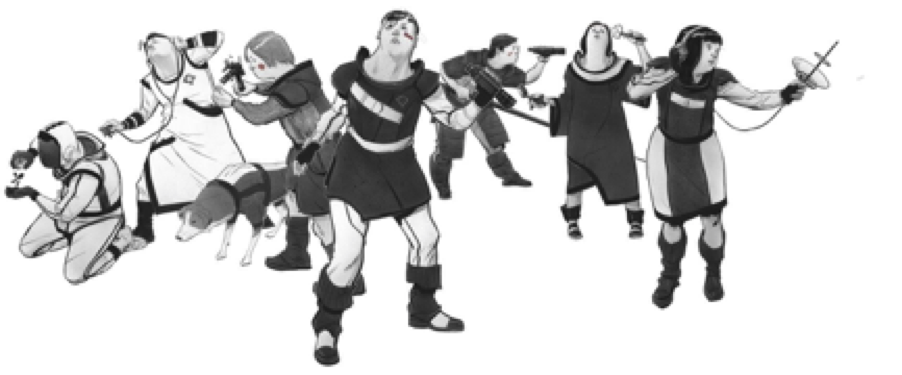
The framework of the exhibit is a fictional story devised by the TOUCHDOWN team: a spaceship with seven astronauts and one dog lands on the roof of the Art and Exhibition Hall in October 2016. This is the “Second Mission” from the planet kUMUSI, and all of the space travelers have Down syndrome. Once on Earth, they visit the descendants of planet kUMUSI’s “First Mission” and learn not only about the life of people with Down syndrome on Earth nowadays, but also about their history over the last 5.000 years. The exhibition presents the result of the Second Mission’s research and observations, and the trip’s log book accompanies the exhibition. Artist Vincent Burmeister presents this background story as a comic. Cartoon figures drawn on the walls guide visitors through the exhibition, as well as through the various sections of the accompanying book.4 Burmeister maintained close contact with the TOUCHDOWN team while he was developing the characters. The strong, tough, and self-willed figures are curious and eager to learn and have minds of their own with specific world-views and judgments about what they see and perceive.5

The exhibition begins in the foyer of the Art and Exhibition Hall with the landing of the Second Mission on the roof. The Second Mission characters are introduced on the way into the main exhibition space.
The second room, entitled “Today – Here and Now,” addresses the everyday-lives of individuals with Down syndrome. How do they live? What sorts of jobs do they have? What kind of music do they listen to? How do they deal with grief? Are they in love? What do they aspire to? What do they find annoying? The team-members who played a central part in the conceptualization of this room have very different answers to these questions. Individuals with Down syndrome provided most of the objects and artwork on display here and also composed the corresponding texts.
The third room (“The Invisible – Seeking Traces in the Past”) contains displays that might represent forms of existence of individuals with trisomy 21 over the past 3.500 years. But historical discovery has to remain speculative.
The fourth room is dedicated to the life and work of John Langdon-Down (“The Big Show – John Langdon-Down.”) In the 1860s, John Langdon-Down established in two institutions in England that provided a comprehensive therapeutic support system for individuals with cognitive differences. “Down syndrome” is named after him. Some of the individuals with Down syndrome in the TOUCHDOWN team appreciate and value his work, especially his respectful interaction with individuals with Down syndrome. This room also addresses the evolution of the term “Mongolism” and clarifies why individuals both with and without Down syndrome reject it.

The murder of individuals with physical and/or psychological differences during the Nazi era is the theme of the fifth room of the exhibition (“In Semi-Darkness – The Extermination”). According to the Nazi classification system, individuals with Down syndrome were declared as “unworthy life” and either sterilized by force (starting in 1934) or systematically murdered (starting in 1939).

TOUCHDOWN team members with Down syndrome think it is important to discuss this topic during their guided tours. Because some of the concerned do not want to speak themselves, they deliberately allow their tandem partners to lead the discussions. The tandem team prepares their visitors for this exhibition room and offers them the choice to decide if they would like to enter the room or not.

The sixth room of the exhibition presents topics from the field of research, health, and family (“Research – I am what I am”). In this room, prenatal diagnosis is explained as well as the decisions pregnant women are confronted with when they are carrying a fetus with trisomy 21. In the course of preparations for the exhibition, the TOUCHDOWN team participated in a workshop on the topic of abortion. Individuals with Down syndrome developed and produced the displays on view in this section of the exhibition.

The seventh and last room, entitled “The Discussion – Go or Stay?” provides visitors with an opportunity to evaluate their experiences during their tour through the exhibition. The exhibition protagonists – both the individuals with Down syndrome on Earth and the space travelers – summarize their arguments in a radio play installation, leaving the conclusion to the story open-ended. Visitors are invited to participate in the discussion by writing their opinions on pieces of paper and putting them in a box in the middle of the room.

Conclusion

The research questions that I raised at the beginning of this article can only be answered briefly here. My field research has shown that collaboration between individuals with and without Down syndrome, both in the preparation of the exhibition and in the exhibits themselves, can be successful under three conditions: first, people have to deal respectfully with each other, second, they must have enough time to work on the content together, and third, they have to develop a common narrative for the guided tours. In the case of this specific project, the participants had already developed strong relationships with one another over years of collaborative work for the “Ohrenkuss”-magazine.6 On the editorial staff everyone is treated as different, but equal, a principle that was also vital for the success of the TOUCHDOWN exhibition. The “Ohrenkuss” editorial staff also tested assisted7 work settings before this form was expanded during the exhibition preparations. Individuals with Down syndrome get more than only a chance to speak in the exhibition. Rather, they can present their own topics, and their everyday lives are portrayed from their own perspectives. Persons speak as experts of their own situation. They have decided themselves how they want to be (re)presented and what they want to present. Participating experts without Down syndrome have also presented their research results to the TOUCHDOWN team as part of the exhibit development process. If pictures or objects utilized in the presentation were not explained in klarer Sprache (Clear Speech),8 these materials, texts, and artifacts were prepared and/or translated by assistants to make them understandable to everyone. Julia Bertmann, a member of the advisory board with Down syndrome, evaluated the comprehensibility of the exhibition, suggested changes and authorized the texts. All texts in the exhibition and its accompanying exhibition book are written in klarer Sprache and only in klarer Sprache, as is the website for the TOUCHDOWN21 research project.
History is going to be written:
“[…] as an emancipatory, participation-oriented project. Its protagonists’ guiding principle is to change societal views and practices so as to enable individuals with particular physical characteristics and health issues to enjoy full subject status and unlimited participation.”9
The organizers of the TOUCHDOWN exhibit dedicated themselves to this vision. Through their work, they attempted to deliver initial responses to the core questions10 of Dis/ability History as it concerns Down syndrome.
As the first exhibition of its kind in the German-speaking world, the TOUCHDOWN Exhibition did not just achieve an important milestone in the field of Public Disability History. It demonstrated that extensive research has to be done in order to deliver new insights into the past realities of individuals with Down syndrome.11

Links


Recommended Citation:
Thea Jacob (2017): Doing Public Dis/ability History – The Touchdown Exhibition at the Art and Exhibition Hall of the Federal Republic of Germany in Bonn | 29 Oct. 2016 – 12 Mar. 2017. In: Public Disability History 2 (2017) 5. 


Footnotes:
[1] Informational material for potential borrowers at the Touchdown exhibit, p. 1, as of February 2016 (in the author’s possession). Can’t insert comments in footnotes, so will just say that I think “For potential borrowers is super awkward and I would replace it with “available”↩
[2] Public History is understood “as history for the public,” “history in public,” or “applied history.” The term is used both in the sense of the American pioneers of the field, who intended it to refer to history done by non-academics in public spaces, as well as “the teaching and analysis of the dissemination of historical knowledge to a wider public.” See: Zündorf, Irmgard: “Zeitgeschichte und Public History, Version: 1.0.” In: Docupedia-Zeitgeschichte, 11 Feb. 2010, URL: https://docupedia.de/zg/Public_History↩
[3] I have utilized the methods of “participatory observation” from the field of Ethnology as the basis for my own research. I attended TOUCHDOWN21 team meetings, events, and tours and took field notes that will serve as the foundation for comprehensive records that will in turn serve as my main sources. ↩
[4] Kunst- und Ausstellungshalle der Bundesrepublik Deutschland, Bonn: TOUCHDOWN. Die Geschichte des Down-Syndroms, Bonn 2016.↩
[5] See Kunst- und Ausstellungshalle der Bundesrepublik Deutschland, Bonn: TOUCHDOWN. Die Geschichte des Down-Syndroms, Bonn 2016, p. 10-33.↩
[6] “Ohrenkuss – da rein, da raus” (Ear Kiss – Goes In There, Goes Out There) is a print magazine written by people with Down syndrome. It was started in Bonn in 1998 by Dr. Katja de Bragança. Today the magazine employs individuals nationwide. See http://ohrenkuss.de/projekt/historie and http://ohrenkuss.de/projekt/uber-ohrenkuss↩
[7] See Kunst- und Ausstellungshalle der Bundesrepublik Deutschland, Bonn (Hrsg.): TOUCHDOWN. Die Geschichte des Down-Syndroms, Bonn 2016, p. 8: “In this book, individuals with Down syndrome share their viewpoints with the world [Author’s note: they do this in the exhibition itself as well]. They talk about their lives and their day-to-day routines here and now, and they express their wishes for the future. They do this independently and with self-confidence. This required support. […] Numerous assistants supported the individuals with Down syndrome and opened up opportunities for them. They supported the processes without controlling or influencing them.“↩
[8] What is Clear Speech? Clear text is simply comfortable for everyone. Another important difference is that Clear Speech utilizes foreign words whenever they are necessary. […] The technical terms that are needed for a text are explained and then used consistently throughout the text. […] There is one more point that is important for clear speech: only a person who is interested in a topic can understand a text written in clear speech.”↩
[9] Waldschmidt, Anne/Schneider, Werner: “Disability Studies und Soziologie der Behinderung. Kultursoziologische Grenzgänge – eine Einführung.” In: Disability Studies, Kultursoziologie und Soziologie der Behinderung. Erkundungen in einem neuen Forschungsfeld. Bielefeld 2007, p. 9-28, here on p. 13.↩
[10] “How is the ‘Different’ distinguished from the ‘Normal’? Which scholarly discussions, political and social state interventions, and institutional control mechanisms determine the historical development process of a category like disability? […] How does mainstream society construct its normality in and through the design of a particular iconography of differences?” See Bösl, Elsbeth/Klein, Anne/Waldschmidt, Anne: Disability History: Einleitung, in: Disability History. Konstruktionen von Behinderung in der Geschichte. Eine Einführung. Bielefeld 2010, p. 7-10, here on p. 8. As described above, this pertains above all to rooms three, four, and five of the exhibition, which specifically address historical topics.↩
[11] An in-depth analysis of the R179 patient files in the Federal Archives in Berlin with regard to the personal histories and the history of the persecution of individuals with Down syndrome during the Nazi era would also be worthwhile. Further ancient-DNA-analysis could also provide insight into the lives of individuals with Down syndrome in the very distant past.↩

October 31, 2016

Parents on the March: Disability, Education and Parent-Activists

By Teresa Hillier, Swansea University

At a time of great social change in mid-20th century Britain there was a series of parliamentary reforms which aimed to help rebuild a war-torn society. These included a focus on education with the 1944 Education Act aiming to provide equality of opportunity to children. However, many children with cerebral palsy and related disabilities were classed as ineducable under this Act. This led to parents campaigning on behalf of their children against this perceived injustice. These parents were pioneers and disability activists, drawing public attention to the exclusion from education of their children. As a result of this direct action many parent-led organisations were established during the 1950s one of which is Longfields Association originally known as Swansea and District Spastic Association.

Legacy of Longfields is a two-year research project that will examine and share the history of the Association. The organisation was set up in 1952 by a group of parents of children with cerebral palsy to provide them with the opportunity for education. This led to the first school of this kind in Wales opening in April 1953.

First children to attend

The idea for recording the history of Longfields began while I was employed there from 1999 to 2004. I became more aware of the history of the organisation, the effort of the parents and the part that the organisation had played in disability history and the history of Swansea. The catalyst for this project was the sudden closure of the organisation in 2011. After a few years and changing circumstances a successful Heritage Lottery Fund application was made. The application highlighted the fact that only limited formal research had been undertaken on the Association and there was a danger it would be forgotten following the closure. The effort of campaigning by parents at that time is largely overlooked but through the project their story can be told. Tribute can be paid to the founder members and those who gave tirelessly of their time. Through my involvement, I knew that individuals cared passionately about Longfields and it touched many lives. Those involved in the early days are elderly and without the project their memories would be lost.

Swansea mayor presents key to new school 1952

In 1955 the school moved to new premises where the first ‘spastic nursery’ in Wales was opened. As well as offering education for these children, Longfields provided job opportunities to some of its former pupils at the Work Centre in 1962 and the Occupational Therapy Unit which opened in December 1967. After many successful years providing services to individuals throughout the Swansea area the organisation closed in 2011. The project is still at an early stage but engaging with individuals who attended the centre, their families and friends has provided some valuable resources such as video footage, a scrapbook and press cuttings.

Researching the history of this organisation reveals how successful it was in engaging the public to support its cause. An extract, by Bill Paton, from the first Year Book of the Association, printed in 1960 illustrates the passion that the parents had in forming the organisation. The aim to engage with the public on disability issues was one of their key objectives. To achieve a wider impact, they gave talks to community groups, lobbied their MP and local council. Articles in local and national press, together with fund raising activities, highlighted the work of the organisation and contributed to the debate around the education of children with cerebral palsy.

Extract from the first Year Book of the Association

Not content with working at a local level the Association engaged with other established organisations to campaign nationally. Affiliation to the National Spastics Society (NSS) resulted in Bill Paton becoming a member of the Society’s Executive Committee. This meant that the Association had more support for their activities and access to a wider range of resources. The NSS succeeded in getting ‘parents on the march’. Their five aims were
  • Tell Britain about Spastics
  • Discover the Spastics and their parents and bring them into Groups
  • Increase the number of Parent’s Groups to cover England and Wales
  • Unite these groups in one strong and effective body Raise money to help set up treatment, schooling and social centres more quickly than if the job was left entirely to Local Authoritie
The term “spastic” is not acceptable in modern society. However, it is important in an historical context to understand how the medical model of disability categorised individuals.

To achieve these aims the NSS brought the ‘plight of spastics’ to public attention using statistics to compare the number of children with cerebral palsy against those with other disabilities. By displaying images of children as objects of pity, using ‘tragedy’ to evoke sympathy they enhanced fundraising. A targeted media campaign and production of a documentary film, Chance of Their Lives (1952) further highlighted the issues.

As part of the project, oral histories will be collected to not only discover individual memories of Longfields but to reveal the experiences of those who attended the organisation from childhood to adulthood. Challenges arise as some of these individuals cannot participate unaided and so their contribution may be influenced by a family member. Memories can become distorted over time and recollections may be coloured by a desire to present a more idyllic past.

My research has begun to bring the origins of Longfields to life. Despite the problems described above, collection of oral histories and the input of pupils from local schools will enable a more dynamic memory of Longfields to be created. The project will deliver an exhibition at the National Waterfront Museum and an online accessible archive. Elements of the exhibition will then be made available to local schools and community groups taking the history of Longfields into the communities it served.

Recommended Citation:
Teresa Hillier (2016): Parents on the March: Disability, Education and Parent-Activists. In: Public Disability History 1 (2016) 19.


All pictures from West Glamorgan Archives in Swansea 

September 12, 2016

Doing Public Disability History

By Daniel Blackie

The clue is in the name. Public disability history is ultimately about getting people – the public – to think about disability history. Simple as that. Only it’s not really that simple, is it? As I’ve found out over the past few years, doing public disability history is actually quite challenging.

The first, and most important, thing to consider is how to reach the public? During the Disability and Industrial Society project I learned that there are many ways to do this and that the best public engagement strategies employ as many of them as possible.

For example, our public engagement programme included a touring museum exhibition, public lectures, panel discussions and workshops, as well as regular blogposts, tweets, podcasts and pieces in the popular media. Although very different formats, all involved writing to greater or lesser extents. The text for the panels displayed in the exhibition, the notes for lectures, the emails back-and-forth with journalists. Writing, writing, writing. And this is something disability historians have to think about when doing public history.

Perhaps the most obvious issue in this regard is length. A 140 character tweet, a 150 word exhibition panel, a thousand word blog post, a one hour lecture: all impose space or time constraints that mean we have to choose our words carefully.  As too do people’s attention spans. 

It doesn’t matter how great or interesting the message, there’s only so long you can realistically expect to hold a person’s attention. Short and sweet is definitely best when it comes to public engagement. Language is also important. It’s no good presenting disability history in terms that nobody but specialists can understand. Clear, jargon-free language is absolutely essential if you want to reach as wide an audience as possible. 

Grabbing people’s attention is another challenge. Images and objects can be a help here. I visited our exhibition a few times after it opened at the National Waterfront Museum in Wales.  It was one of several exhibitions visitors to the museum could visit, so we had lots of competition for people’s attention. Every time I visited, I noticed some visitors start to rush past ‘our’ part of the building, presumably on their way to enjoy something else the museum had to offer. Many, however, quickly stopped in their tracks after an image or artefact in our exhibition caught their attention. Most lingered a while and started to examine other aspects of our displays, some at quite great length.

‘Falling in of a Mine’ (1869). One of the images featured in our exhibition
‘Falling in of a Mine’ (1869)
One of the images featured in our exhibition

The perspectives and stories we choose to highlight can also act as ‘hooks’ to entice members of the public to stop and think about disability history. Dramatic historical episodes or incidents, can be especially useful in this regard. 

During our research for the Disability and Industrial Society project, for instance, we uncovered the story of two mining brothers from south Wales – Davy and Griffith Ellis. Griffith had a mobility impairment and used a wooden leg. In December 1865, both brothers were working underground at Gethin Colliery when a terrible explosion occurred. Fearing suffocation from the deadly gases that followed the blast, they attempted to get out of the mine together as quickly as possible. Due to his mobility impairment, however, Griffith had trouble keeping up with his brother and fell behind. Worried that he might not make it to the surface in time, Griffith called out for help and his loyal brother went back to get him. It was a fateful decision as both men perished, overwhelmed by the noxious gases they tried so hard to escape. 

Incidents like this have a clear ‘human interest’ element that appeals to journalists and the general public alike. Emphasising them in our public engagement activities can help make disability history interesting to audiences beyond academia, furthering the field’s broader goals. Who doesn’t like a good story? Good stories (even ones with sad endings) have the power to entertain and hold people’s attention, but the best ones do much more than that, especially in a public history context. 

The drama, excitement, and tragedy of the Ellis brothers’ desperate and unsuccessful flight for safety is riveting, but it is also intriguing and raises lots of disability-related questions. For instance, how were men with significant impairments like Griffith able to work in such a physically demanding and dangerous sector as the nineteenth-century coal industry? By suggesting the question, moreover, the case of Griffith Ellis unsettles popular ideas about disabled people’s capacity for work. This is exactly the kind of thing disability history is supposed to do: challenge dominant disability stereotypes and get people to rethink their attitudes about disabled people. 

Yet this approach is not without potential pitfalls. Using dramatic, exciting, tragic, inspiring or disturbing ‘hooks’ to capture public imagination also risks enforcing some of the stereotypes public disability history seeks to undermine. Without proper contextualisation, for instance, Griffith Ellis’s story might become just another tale of heroic overcoming that feeds the pernicious ‘supercrip’ stereotype disability scholars and activists frequently critique. Alternatively, focusing on his death might promote the idea that disabled people have been little more than passive victims in history. 

Ultimately, of course, we cannot determine or control the interpretations people arrive at when they encounter public disability history. We can suggest a framework for making sense of the images, stories, and objects we present in our public engagement activities, but we cannot compel people to adopt it. At its best, public disability history spurs people to find out more about the still largely hidden history of disability on their own, with friends, or with their families, and gives them some ideas about where and how they might start looking.

Recommended Citation:
Daniel Blackie (2016): Doing Public Disability History. In: Public Disability History 1 (2016) 16.


July 18, 2016

A life less worth living: "Agent Orange" and the representation of disability in the War Remnants Museum

By Gaby Admon-Rick and Ahiya Kamara

Photo of Neuygen Thi Men
Neuygen Thi Men
Neuygen Thi Men lives in the Vu Thu district, Thai Binh province. When the original photo was taken by the photographer Doan Duch Minh, she was 21 years old. "Tragically," as the text beneath the photo reads, "she must remain in a cage-like enclosure all her life. All day long, Men attempts to chew and swallow anything within her grasp. Suddenly, as she recognizes her father, she extends her hand through her enclosure, reaching for him. Her father, Nguyen van Hang spent fighting in the Trung Son Mountains he was contaminated by Agent Orange."

Neuygen Thi Men and many more people with disabilities are presented at a special exhibition on Agent Orange at the War Remnants Museum in Ho Chi Minh City. The Museum is a "must" for visitors to Vietnam, interested in learning about the Vietnam War from a Vietnamese perspective. Like many other war museums all over the world, the museum includes details of the war, its atrocities and casualties, and describes the military actions and weapons of destruction used. Towards the end of the visit, the visitors are led to a special exhibit on "Agent Orange".

Agent Orange was the military name of herbicides used by the US Military during the Vietnam War in order to destroy crops, bushes and trees in order to gain a tactical advantage over the Viet Cong while fighting in these areas. The exhibition emphasizes the relationship between the exposure to Agent Orange and birth impairments. It is claimed, that this substance has led to the birth of 150,000 impaired children since the Vietnam War until today. While the issue raises many questions, we would like to focus on the way disability is portrayed in this exhibition influencing the way millions of visitors every year understand disability.

Photo of Le Van Hung
Le Van Hung
The exhibit starts with an explanation about the substance and its uses, and then continues with hundreds of photos of disabled people, in what seems to be a "freak show" of photos depicting extreme deformity, misery and tragedy. As the visitors walk through the exhibition they read stories of other people with disabilities, like the story of Le Van Hung, from the Commune Dong Thinh in District Dong Son, Thanh Hoe Province. He was 23 years old when this photo was taken. His parents had fought in the war in 1971. The photo depicts him in a position that resembles an animal, and the text beneath the photo says: "He cannot stand with his legs parallel but he can crawl to get around by his hands, take straw and cook for helping his family day."

Visitors walk through this exhibition with tears in their eyes. They appear heartbroken, overwhelmed by pity and sadness. Maybe they even feel disgust and anger as they gaze at what is portrayed as the "deformed" human body. By this "othering" process, they might also appreciate their own abled body and their fortune, empathize with the victims and feel enraged by the usage of chemicals in warfare.

While the purpose of the exhibition is to convey the horrors and tragedy of the war, it uses the images of disability to do so. Through the portrayal of disability in the exhibition, the visitors learn that impaired people have no meaning to their life and they are destined to a life less worth living.  They are told that people with disabilities are not able to perform daily activities and – as a result – are destined to be excluded, live in poverty, become dependent on others and never gain education or employment. It is not mentioned that services, assistive equipment or technology could be provided or that the governments have a crucial role in social services, combating stigma and making environments accessible. Indeed, for people with disabilities in many places in the world, this seems to be the reality of life.  With limited resources invested by the state, people with disabilities are not able to achieve full participation in all areas of life, as required by the UN-Convention on the Rights of Persons with Disabilities.

Walking through this exhibition, we couldn't stop thinking what the people in those photos would say if they were asked about their lives. How would they represent themselves? How would they tell their life story if they had the opportunity to do so? What are their hopes and dreams? Would they be concerned about the lack of services and discrimination? What would they think about the public images of persons with disabilities and those portrayed in this exhibition?

Photo of Lai Van Hung, 20, and Lai Van Manh, 19
Lai Van Hung, 20, and Lai Van Manh, 19.
"Lai Van Hung, 20, and Lai Van Manh, 19. Each suffers from the same physical disabilities: they are paralyzed, brain damaged, unable to speak coherently, and must spend their days lying on a wooden bed in a corner of their house."

Recommended Citation
Gaby Admon-Rick & Ahiya Kamara (2016): A life less worth living: "Agent Orange" and the representation of disability in the War Remnants Museum. In: Public Disability History 1 (2016) 14.
__________________
Notice: Photos of exhibit were taken by authors for illustration purposes.

July 4, 2016

Making of an accessible exhibition on Disability History. Experiences from LeibEigenschaften. Der „beschädigte“ Körper im Blick der Vormoderne [The pre-modern view on the ”impaired” body]

By Sonja Kinzler (curator)

Although calls for accessibility aren’t new, still relatively few curators are devoted to accessible shows. The exhibition LeibEigenschaften1 was part of the the DFG-funded research project "Homo debilis" at the Bremen University History Department. The 100 square meter exhibition was on display in the Bremen House of Science in March and April 2012. LeibEigenschaften aimed at a high level of accessibility and succeeded thanks to the interest among the involved parties to create something beyond the traditional modes of communication in museum displays, creating a choice of channels to receive the contents (vision, sound, touch; accommodation of cognitive and mobility restrictions). That the topic itself was Disability History was an important motivation for the team behind the exhibition.

Cordula Nolte, Professor in Medieval History at Bremen University, realized this potential early on and actively sought cooperation with local disability activists, a curator (myself), exhibition designers (ZwoAcht), and students from Bremen University and Bremen University of Arts. This concentrated competence made it possible to realize the project even on a limited budget. The exhibition was made to fit the House of Science. There was a great interest, however, in adapting it as an accessible, traveling exhibition, but those plans had to be cancelled due to lack of funding.

Lucas Cranach the Elder: “Jüngstes Gericht, heilige Elisabeth  und heilige Magdalena”, 1519. Collection of the Veste Coburg.
Lucas Cranach the Elder:
“Jüngstes Gericht, heilige Elisabeth
und heilige Magdalena”, 1519.
Collection of the Veste Coburg.
Purpose of LeibEigenschaften was to present living conditions and coping strategies of physically (and mentally) conspicuous people in the pre-modern period. The conceptualizing process started with us finding an agreement on what we considered to be the most important characteristics of the period in general, and deciding against a chronological presentation. We put emphasis on countering popular misconceptions about the way embodied difference was dealt with at the time: No, suffering wasn’t generally seen as divine punishment, and "disabled" persons weren’t necessarily abused and ostracized. We decided to do this without repeating and correcting the misconceptions but instead presenting and illustrating state-of-the-art interpretations of the topic. We also decided not to make explicit connections to the present, which allowed the visitor to experience a distant (in time, not space) culture populated by "cripples" and "raving maniacs", but without a trace of modern medical and social interpretations. Any connection to own experiences and similarities to the present were left to the visitor. This is why, also, the concept "disability" did not play a part in the exhibition, except for a brief introduction where we explained that the exhibition does without that term. However, in the texts in simple German we provided, the term was used, as we were unable to agree on another designation that was easily understandable. As mentioned, the exhibition wasn’t chronologically structured, but we needed to structure it somehow to make it comprehensible.

We immediately decided against arranging it according to types of "disability", not only because this would go against the perspective outlined above, but also since this kind of categorizations doesn’t fit the sources we presented. Instead, we used the topics "Mobility and Activity", "Care and Aid", "Back-Breaking Work – Illness and Health", "Miracle Cures and Miraculous Bodies", and "Admiring – Beholding – Concealing – Looking Away". This followed the structure of the "Homo debilis" project.

These themes were well suited to be translated to symbolic spaces that were important for pre-modern lifeworlds, especially relating to embodied difference: the bed, the street, the shrine, and the cabinet of wonders.
The exhibition designers were able to partially recreate a shrine and a cabinet of wonders on site. In the shrine, the visitors were confronted with the great significance of religion in the pre-modern worldview, and in the cabinet of wonders, the gaze on the conspicuous body and reactions towards "different" people were highlighted. The "bed"-section dealt with caring and nursing. The largest section was "the street", where the public sphere, labour, and physical aids were addressed.
Although the exhibition couldn’t go on the road, it did result in a number of publications that makes the contents and concept available to a wider audience. It was important to us to collect our experiences and make not only the contents, but the practical know-how we accumulated publicly available. We did this in the volume "Wissenschaft für Alle – in Ausstellungen barrierefrei präsentieren" [Science for all – How to make accessible exhibitions, edited by Cordula Nolte and Sonja Kinzler, Kiel 2012],  a making-of story and a handbook for accessible exhibitions. It details the whole process working with LeibEigenschaften, from planning to the end evaluation. The book includes viewpoints from several experts, giving their perspectives on different aspects of accessibility: mobility, hearing, vision, and comprehension. They offered many insights that are hopefully valuable for future accessible shows.

Through this project came the realization that creating an accessible exhibition lets you learn a lot about curating. It trains you in opening different ways to access the contents. Curators should be aware of this from early on in the process and communicate it to the funding institutions: creating accessible exhibitions doesn’t mean spending a lot of money on a small minority of visitors. While making exhibitions available to everyone is important and in the end a question of democracy,  dismantling barriers benefits everyone.

For further reading, see also:
www.leibeigenschaften.de

References:
  • Cordula Nolte, Sonja Kinzler (Eds): LeibEigenschaften. Der „beschädigte“ Körper im Blick der Vormoderne, Bremen 2012
  • Sonja Kinzler: ”Wissenschaftstransfer in eine barrierefreie Ausstellung. Anmerkungen zur inhaltlichen Konzeption der Ausstellung LeibEigenschaften - Der ‚beschädigte‘ Körper im Blick der Vormoderne”, in: Cordula Nolte (Ed.): Phänomene der „Behinderung“ im Alltag. Bausteine zu einer Disability History der Vormoderne, Korb: Dydimos 2013, 25-36
Recommended Citation
Sonja Kinzler (2016): Making of an accessible exhibition on Disability History. In: Public Disability History 1 (2016) 13.

1 The title is a play with the German word for serfdom, „Leibeigenschaft“, which can be divided in „Leib“, body, and „Eigenschaft“, property in the sense of characteristic.↩

May 24, 2016

Subversive Access: Disability History Goes Public in the United States

By Catherine Kudlick
(Paul K. Longmore Institute on Disability, San Francisco State University)

In summer 2015, the Paul K. Longmore Institute on Disability at San Francisco State University mounted an interactive, multi-media exhibit “Patient No More: People with Disabilities Securing Civil Rights". We faced several daunting challenges that ultimately made our installation like no other. In fact, we have been sharing our process with museum professionals and continue to learn as we go.

First, the story itself: on April 5, 1977, more than 100 Americans with and without disabilities began a twenty-six day occupation of San Francisco’s Federal Building to insist on getting civil rights. Four years earlier, Section 504 of the Rehabilitation Act of 1973 made it illegal for any facilities or programs funded by the national government to discriminate against disabled people. One official’s signature stood in the way of the law taking effect. After four years of waiting, a coalition made up people with different disabilities launched protests across the country. San Francisco’s occupation proved the most involved and successful. In fact, thanks to support from local community groups like the Black Panther Party, Glide Memorial Church, the Gay Men’s Butterfly Brigade, as well as local and national politicians, it remains the longest unarmed take-over of a federal building in US history. The occupation itself and subsequent victory gave birth to a national disability rights movement and helped pave the way for passing Americans with Disabilities Act (ADA) thirteen years later in 1990.

May 9, 2016

T4 and public disability history in Sweden

By Matilda Svensson Chowdhury

The boy in the black and white photograph is smiling widely at the camera. He is well-groomed and well-dressed in a white shirt and a dark jacket. His eyes are glistening. This photograph is the first picture in a Swedish exhibition on Aktion T4. Across the boy's chest there’s a turquoise text: “Aktion T4 – on the view of human beings in Nazi Germany”. The boy in the picture is named Robert and a little further in the exhibition, we learn how his mother cunningly was able to could save him from becoming a victim of T4.

Picture of Robert, exhibition on Aktion T4

The Living History Forum (The LHF) is a Swedish public authority [myndighet] which, on behalf of the Swedish government, shall “promote work to enhance democracy, tolerance and human rights with special focus on the Holocaust.” It might seem a bit strange to have a public authority working with these issues, but this is the way it has been in Sweden for the last almost 20 years. A large part of the work the LHF is doing is directed at school children and thus there is almost always an educational framing to the produced material, for example in the form of teachers’ guides. One of the first information materials, which was developed already in 1998, was the book “Tell Ye Your Children...”. This book was however intended primarily for an adult audience and came about as a part of the first information campaign, Living History. To date, more than 1.5 million free copies have been distributed in Sweden.

April 25, 2016

The Portrait of a Sixteenth-Century Disabled Man

By Volker Schönwiese

Gazes at women and men with disabilities from the early modern times up until today – how can they be interpreted scientifically and artistically? A painting from an unknown disabled man from the 16th century that has not been taken notice of until then was the starting point of a participatory and transdisciplinary project in 2005/2006. The portrait is part of the “Kunst- und Wunderkammer” (Cabinet of Arts and Wonders, founded by Archduke Ferdinand II of Austria, Region of the Tyrol [1529-1595]) at Ambras Castle near the city of Innsbruck/ Austria. The Institute of Educational Sciences at the University of Innsbruck, the Museum of Fine Arts (“Kunsthistorisches Museum”) in Vienna with its collection at Ambras Castle and the Centre for Independent Living in Innsbruck were the project partners of this research project. The project´s main goals were the creation and organisation of an exhibition at Ambras Castle and the publication of a scientific anthology with collected articles. Both goals were achieved in cooperation with a reference group of women and men with disabilities. Additionally, a television documentary was created. The participatory approach of the project should finally lead to recommendations for working with reference groups as a way of transdisciplinary participation.

During the duration of the project, two other historical paintings were found that are also significant for the analysis of the cultural representation of disability: a leaflet from 1620 showing Wolfgang Gschaidter, a carpenter with a disability [1] and a small picture from 1578, showing Elizabeth, a woman with a learning disability [2].