June 19, 2018

Blinde und Kunst celebrates its 25th anniversary

By Siegfried Saerberg

I. Darkness as the womb of “Blinde und Kunst e.V.” (BuK)1

In the year 2018 the association “Blinde und Kunst” [BuK] - blind people and the arts - celebrates its 25th anniversary. BuK was founded in 1993 in Cologne as a nonprofit organization of blind, visually impaired and sighted artists, as well as blind or visually impaired people who are interested in the arts.

Audio:
Leslie Ann Hewitt sings “Lilac Wine”, recorded 2013 in Cologne

© Blinde & Kunst.

BuK includes musicians, composers, writers, actors, sculptors and those who are just interested in culturally [de]constructing/presenting blindness in a new way. Its rise coincided with and inspired the beginning of the “darkness-movement” in Germany. By this term I mean activities such as “dialogue in the dark” and several dark restaurants and cafés presented and organized by blind people.2 Thus, guiding sighted people into the dark in order to get on equal terms with them was our initial aim.

We developed a dark show which we called “Black Out” including music, dance, theatre-play, literature, stand-up comedy and magic.

Audio:
Niko Valentino presents his dark magic show, recorded 1996 in Hamburg
© Blinde & Kunst.

[DescriptionYou hear music from a violin and a guitar. Then Niko exclaims: “Good evening, I am the magician with the pony tail. I have dressed up for you – but I am not sure whether you have already realized this.”]

The dark show also contained everyday activities such as finding one’s seat, finding the washroom and the exit, ordering a drink and paying in an entirely dark social situation. In 1993 for the first time “Black Out” celebrated blindness together with sighted guests and blind and sighted artists in a little theatre in Hamburg called “foolsgarden”. By 2007, “Black out” had been hosted at more than 100 events all over Germany, Belgium and Austria.

II. Producing radio programs and exploring blind culture

In 1995, BuK started to produce an acoustic magazine first on cassette and then on CD that was only distributed among its members. It contained more than 30 samples with around 35 copies which were sent via mail to each member. Between 1997 and 2000, we worked together with a broadcasting company in the south-west part of Germany [SWR] with the idea of presenting radio plays in darkness. A radio play called “Café Finsternis” resulted from this project.

Audio:
Tommy Ahrens and his guide dog Kelly singing the blues, recorded 1997 in Freiburg.
© Blinde & Kunst.

[DescriptionTommy talks to his dog Kelly, then he plays the harp, Kelly sings.]

In 2004, we started to produce radio programs on our own and we still do this today in a local radio station in Cologne called “Freier Bürgerfunk”. From 2010 to 2012, together with “Radiofabrik” in Salzburg [Austria] we took part in a European culture program called “Ohrenblicke” [Ear Glances] to develop our technical and journalistic skills. Such radio programs are intended to present elements of blind culture to a wider public.

III. BuK explores blind arts

Our next goal was to develop special expressions of art that could be appreciated in the dark in order to make it more accessible for blind and visually disabled people. Between 1995 and 1997, BuK conceptualized three exhibitions in total darkness in Bergisch-Gladbach, Hamburg and Cologne, together with local associations of artists and the local association of blind and visually impaired people. The exhibition was called “Sinnenfinsternis” [eclipse of the senses] which is a play on words of the German phrase “Sonnenfinsternis” [eclipse of the sun] – with a forthcoming cosmic event on 11th August 1999. Acoustic, tactual, olfactory and gustatory exhibits – and also ostensibly visual ones such as a colour-cabinet for the haptic sensation of colour – were presented in total darkness to a mostly sighted audience.

In 2010, BuK developed the exhibition “Blinde Flecken” [Blind Spots]. The exhibition featured 17 favourite places of blind or visually impaired narrators. Voices, sounds and other audible sources were tape recorded to create an auditory portrait. Visitors could listen to these voices and sounds in dark booths via headphones. These recorded sounds were also presented on CD. 

Audio:
“3541 Miles” by Robbie Sandberg, published 2011.
© Blinde & Kunst.

[Description: You can hear a lot of different sounds. Then the author asks, what it is that drives a blind backpacker away from home. He answers that it is just the same thing that leads all backpackers into the world: To discover new things experience other people and different cultures and the lust for adventure. “Every city, every region has its own impact on the senses”, he says. Now you can hear several sounds of public travel like London Underground, San Francisco Cable Cars or Hamburg S-Bahn. Then you can hear a soundscape from India. The author concludes: “To experience with my own ears a sound that you normally only hear by watching an animal film tells me how far I am away from home”.]

In 2013, we transferred our concepts from dark environments to a lighted context now focusing on art exclusively produced by blind or visually impaired artists. Every work of art could be touched, was audio-described and a guiding system led through the exhibition.

Photo:
“Tapestry I”. Fire screen, cutlery, gardening tools, 2012 by Marian Edwards for the exhibition “Art Blind” (17.5.2013 – 17.6.2013) im Stapelhaus, Cologne.

Photo: Victor Dahmen, © Blinde & Kunst 2013
[Description: The object is a Victorian fire screen, an article of daily use which is placed in front of an open fireplace to prevent sparks from flying into the room. Fixed to its surface are carelessly discarded gardening tools and rusty, tarnished, dented, and bent cutlery. The objects are arranged in a very symmetric pattern both next to and on top of each other. We find scissors, fish knives, a small rake, and a little shovel. Tea and tablespoons of different sizes are placed in a row. With two exceptions, their handles point upwards and their inner surfaces face us.
Those are items which remain behind when a house is emptied out or when the attic is cleaned. They are the remains which remind us of a bygone life.
The artist writes, "I am fascinated by the way the light falls onto these objects and how the colours of the tarnished silver and discarded metal change. How we deal with objects and how we combine losses and memories that way."]

These exhibitions attempt to conceptionalize art and exhibitions beyond the limitations of the eye. They are also examples of the ways in which art exhibitions, from their initial conception, can be designed to accommodate the cognitive and perceptual culture of blind and visually impaired people. And moreover, they also represent a new and different experience for sighted people as well: the beheld object is not necessarily a visual one. It might also be an acoustic, tactual or gustatory one. So beauty does not only lie in the eye of the beholder. It also lies in the cognitive, perceptive and habitual procedures of the beholder’s body and mind.

IV. Conquering the citadels of art

From 2015 to 2017, we worked together with four major museums in Germany in a project called “Pilot Inklusion”. Together with Bundeskunsthalle in Bonn we worked on three exhibitions: “Japans Liebe zum Impressionismus” discussing the relationship between European impressionism and traditional art in Japan; “Pina Bausch und das Tanztheater” exploring the work of this extraordinary German choreographer from a bodily perspective, and “Wetterbericht”, dealing with the very subjective experience of weather as well as with global climatic changes. Besides implementing many tools to make the exhibitions accessible we presented works of art created by people with disabilities as a part of the exhibition.

Photo:
“Wolken, Textile, 2017 by Michael Gerdsmann, Die Schlumper (Hamburg) for the exhibition "Wetterbericht. Über Klimakultur und Klimawissenschaft" (7.10.2017 - 4.3.2018) in Kunst- und Ausstellungshalle der Bundesrepublik Deutschland, Bonn.
Photo: David Ertl © Kunst- und Ausstellungshalle der Bundesrepublik Deutschland, Bonn

[Description: You can see a woman touching some crocheted clouds hanging in the air. The clouds are in different sizes and made out of wool. They vary in colour between white and black. Behind the woman you see her guide dog laying on the exhibition floor.]

Photo:
“Welle im Auslauf” by Karla Faßbender for the exhibition "Wetterbericht. Über Klimakultur und Klimawissenschaft" (7.10.2017 - 4.3.2018) in Kunst- und Ausstellungshalle der Bundesrepublik Deutschland, Bonn.
Photo: © Blinde & Kunst.

[Description: You can see a wave made out of alabaster. It is rather a smooth and soft wave than a big one. It feels like you lay your hand on the watery surface of the Northern Sea on a very calm morning.]

We also worked together with “KUNSTHAUS KAT18” in Cologne where many artists with learning disabilities produce their works. Widening our scope from blindness to disability in general, the project dealt with three major topics concerning the relationship between culture, arts and disability:
  • Accessibility: All arts must be made accessible to disabled people. Not a single kind of art may be excluded. This needs to be done in a process of transformation.
  • Multisensory [Tactile, acoustic and audio-descriptive] elements must be implemented
  • The permission to touch original sculptures
  • The availability of copies that are as close to the original in form, material and size
  • Multi-cognitive strategies [simple language, diverse languages] must be applied
  • Special guide services and guide systems should be available
  • Professionalization so that disabled co-workers will be hired in museum-contexts as volunteer work may not be the appropriate basis
  • Inclusion: The process of transformation should involve the communication of at least three groups: people with disabilities who should be the subject of transformation, the museum experts who know about the objects and their cultural context, and disabled artists who are best-equipped to encapsulate this process of transformation. This communication must be instituted within local, regional and national organisations: Every museum, every centre of arts should create a council to work together with groups and organizations within the disability community where this process of transformation can take place.
  • Participation: art and culture in a broader social context should be embedded into the work of disabled artists. The artistic and cultural expression of disabled people should be encouraged, promoted and supported. And because these belong to human heritage, it must be made accessible for the whole of society in museums and galleries.

Accessibility, inclusion and participation should not be added to exhibitions in a second or third remove, but seen as an inclusive making of culture in general. Disability approaches should be embedded already in the first steps of conceptualisation. This also means, that exhibitions should represent disabled people, their arts and their culture. This is, because it is society which makes people disabled. So it is also society which can enable us again. Furthermore, society is also obliged to do so, because society is the overriding factor which enables or disables all human beings in the first place. We are social beings with our own unique culture which yearns to be represented among other cultures in public places such as museums, theatres and galleries. And we as members, producers and recipients of disability culture and disability arts should in the future be able to make our presence felt in mainstream culture and the arts.


Website:
www.blindeundkunst.de


[1] I like to thank Leslie Ann Hewitt and Luke Hewitt for supporting the translation from German to English. Thanks also go to Eckhard Seltmann.
[2] Siegfried Saerberg [2007]: The dining in the dark phenomenon. In: Disability Studies Quarterly, vol 27 no 3, summer 2007. http://dsq-sds.org/article/view/24/24


Recommended Citation:
Siegfried Saerberg (2018): Blinde und Kunst celebrates its 25th anniversary. In: Public Disability History 3 (2018) 9.

May 21, 2018

A Source Edition of the History of People with Disabilities in Germany after 1945. A contribution to Public Disability History

By Raphael Rössel and Bertold Scharf

The list of complaints was long: Inadequate teaching facilities, lack of resident participation, arbitrary distribution of premium payments by the institution’s administration and forced residence in the institutional facilities during job training programs. In the early 1970s, the Bremen rehabilitative institution Friedehorst came under severe criticism by various disability advocate groups and youth clubs.1 To indicate the extent of the misconduct to local politicians, the journalist Gerhard Tersteegen compiled a compendium of the institutional transgressions. His documentation, entitled Heimideologie contra Integration [Institutional ideology versus integration], is only one of the previously unpublished sources featured in Quellen zur Geschichte von Menschen mit Behinderungen (QGMB) that documents the changing cultural realities of people with disabilities in Modern Germany and unearths their constant claims to agency.

QGMB follows the lead of various other disability historians to open the disability archive and eliminate barriers to explore the history of people with disabilities. Whereas American efforts already culminated in a digital disability museum as early as 2000 and other pioneering source platforms have made published journals of the German disability movement (Krüppelbewegung)2 available, unpublished primary material that offers glimpses into the intricate realities of people with disabilities have remained unavailable for larger audiences in Germany – or reserved for the privileged eyes of historians. QGMB attempts to further open the archive for a general audience.

Additionally, to help integrate disability history into mainstream educational curricula, the source
edition is didactically designed for use in both high schools and universities.3 Apart from a search function, the categorization of sources reflects different facets of the phenomena collectively referred to as Behinderung. Even more, the selected material and its encoding permit teachers to give students independent research tasks. As the documents are chosen to offer a variety of viewpoints on a given topic, and balance each other rather than require to be used as a unit, different levels of depth can be achieved according to the teachers, students and curricular demands. To fulfill the demand for multiperspectivity in history didactics, both non-disabled commentators and individuals categorized as disabled are collected in the source edition. Lecturers and high school teacher can select the amount of sources and which viewpoints to look at, and also whether to use the finely encoded sources in more independent or supervised teaching formats.

The project is initially derived from research project People with Disabilities in Germany after 1945. Self-determination and participation in two German states in comparative perspective. A contribution to Disability History that was funded by the German Research Foundation and headed by Gabriele Lingelbach at Kiel University. While the project was finalized at the end of 2017, QGMB assembles the project’s findings as a central archive. However, it is not only a testimony to the individual dissertations by Jan Stoll (Disability Self-advocacy movements in West Germany),4 Sebastian Schlund (West German Parasports),5 Bertold Scharf (Working environments of people with disabilities in the GDR)6 that makes their results available and sets the stage for new disability history projects in Kiel. While the sources are currently categorized according the domains of activism, sports, work, alongside legal texts and stereotypes, the source edition is devised to be enlarged – in categories, periods and territories.

Screenshot of the QGMB website.
Screenshot of the QGMB web site.

Particular attention was paid to long-term availability, searchability and intertextual relations. The documents were encoded with the standard for digital editions in the humanities - TEI. TEI allows not only to mark up the structure of the text but also textual elements like persons, places etc., so they can be directly identified. The faceted search on the web site works like a register and allows cross-referencing of persons, institutions, organizations, key words, places and laws. Each of these is referenced – if possible – with a permanent link to the respective entry in the German national library (DNB). Moreover, in contrast to a printed source edition, it is possible to extend the edition in the future. The usage of TEI also facilities upcoming research: In TEI, different terminologies for disabilities and people with disabilities are indicated and could serve as a foundation for a corpus that helps to uncover discursive changes in the naming and, hence, in the construction, ascription and disavowal of the complex of dis/ability. These encoded concepts include the GDR’s Geschädigte [damaged/defective], the male veterans’ self-description of Versehrte [permanently wounded] and the Sorgenkinder [problem children] that became a frequent reference point after the Thalidomide scandal in early 1960s West Germany. The encoding makes the documents not only machine-readable and searchable, but also qualified with meta-data (bibliographical information, key words and notes on the edition process and responsibilities). The documents will be published in the TextGrid Repository, a digital preservation archive for XML/TEI encoded humanities research data, so the documents will be available also if the web version site should not exist anymore.

The web site is barrier-free and accessible for blind and visually impaired people: It is readable for a screen reader and every picture is linked with an alternative description. Unfortunately, it is not accessible to non-German-speaking people and people with learning difficulties, there is no English version and the texts are not translated in easy-to-understand language.

In its current inception phase, QGMB comprises 37 very diverse sources.  From complaints about institutional repression, such as Heimideologie contra Integration, to leaflets written by the German disability movement, to parasport visuals that speak to the changing cultural ascriptions of mental or physical dis/ability. Moreover, the range is from letters of complaint directed at federal ministries, official advertisements for the Kriegsversehrtenspiele to satirical obituaries of the disability movement for the public service TV lottery Aktion Sorgenkind which was often regarded as paternalistic. Newspaper articles show how the subject was discussed in the public and abstracts from laws and regulations show the handling in politics. Each individual source is amended with a separate commentary by the disability historians of the Kiel project. These commentaries frame the source and reference further research on the topic.

Poster for the 3. Deutsches Versehrtensportfest [3rd German tournament for permanently wounded veterans] on the German island of Sylt. This ad depicts an athletic swimmer joyously waving his arms. The impaired part of his body, however, remains unseen and below the waves of the North Sea.

We hope that we have created a helpful resource for teachers and students to learn more about disability history and provided encouragement to do more in this field. Hopefully, the source edition will only be the beginning of a process.


1 Cf. Lingelbach, G. / Stoll, J. (2013): „Die 1970er Jahre als Umbruchsphase der bundesrepublikanischen disability history? Eine Mikrostudie zu Selbstadvokation und Anstaltskritik Jugendlicher mit Behinderung.“ In: Moving the Social 50, S. 25-52.
2 Lux, U. (2017): "Nothing is forgotten, and nobody!" Archives for the disability rights movement as a disability policy project. In: Public Disability History 2 (2017) 19.
3 Hellberg, F. (ed.) (2016): Disability History: Behinderung in der Geschichte - ein Längsschnitt. Aachen: Bergmoser + Höller.
4 Stoll, J. (2017): Behinderte Anerkennung? : Interessenorganisationen von Menschen mit Behinderungen in Westdeutschland seit 1945. Frankfurt am Main: Campus.
5 Schlund, S. (2017): "Behinderung" überwinden? Organisierter Behindertensport in der Bundesrepublik Deutschland (1950-1990). Frankfurt am Main: Campus.
6 Bertold Scharf’s forthcoming dissertation project is scheduled for release in the same monograph series on Disability History issued by Campus.


Recommended Citation:
Raphael Rössel/ Bertold Scharf (2018): A Source Edition of the History of People with Disabilities in Germany after 1945. A contribution to Public Disability History. In: Public Disability History 3 (2018) 8.

May 7, 2018

The Paris Banquet and the Swedish Deaf Movement, or: A Signed Room on Stage

By Jenny Schöldt
Translated by Ylva Söderfeldt

On May 3, 1868, a group of Deaf gathered together with a few hearing friends – today, we would probably call them ”allies” – at the Manilla Deaf-Mute Institute in Stockholm. The three initiators were the school’s hearing director Ossian Borg, the Deaf teacher Fritjof Carlbom from Tysta Skolan (“The Silent School”, another Stockholm Deaf school), and the artist Albert Berg. Carlbom had paid a visit to Berlin and, inspired by the Deaf club there, had decided to start something similar in Sweden. On this day, twenty-two Deaf and five hearing persons agreed to form the Deaf-Mute Society, Dövstumföreningen, predecessor of today’s Swedish Deaf Association. This remarkable event, a milestone in Swedish Deaf history, celebrates its 150th anniversary this month.

It was the actor Joakim Hagelin-Adeby, chairman of the Stockholm Deaf Society, who came up with the idea to stage a play in honor of the history of the Swedish Deaf movement and the banquets that were held in Paris in the 19th century to celebrate Sign Language. The title was going to be Parismiddagen – the Paris Banquet. His suggestion prompted Tyst Teater, a theatre company that has been performing in Sign Language for more than four decades, an audition for Deaf writers. The framework was in place, and now prospective playwrights were free to be creative.
When I found out about the idea, I immediately envisioned a table in a room, with two Deaf persons seated, signing: artfully, quickly, humorously, like I’ve seen my Deaf friends sit and sign so many times before, and like I’ve done myself. I often think of Sign Language as something that goes on in the room where it is ”spoken”, that can’t be translated or captured. Sign Language is a language without tenses, consisting, put simply, of lexical and non-lexical signs. The non-lexical signs are descriptive verbs that are modified (signs are not inflected) according to context, or created as a result of the syntax. Very much like what happens on a theatre stage.
To write a script in one language that is supposed to be performed in another one, because the latter lacks a written form, is a problem that has been discussed over and over again within Tyst Teater and the rest of the Deaf artistic community.  In the past, for a different project, I had tried writing in a modified Swedish that made it clear how the lines were supposed to be signed. But this solution killed the creativity of the actors, and impeded the artistic work of the director.
I realized that I can’t decide how another Deaf person has to express themselves.
That has to happen in the room. In the conversation.

Actors Joakim Hagelin Adeby and Mette Marqvardsen on stage, seated across from each other at a long table set for a banquet, dressed in historical costumes and signing. Photographer: Urban Jörén
Actors Joakim Hagelin Adeby and Mette Marqvardsen on stage, seated across from each other at a long table set for a banquet, dressed in historical costumes and signing. Photographer: Urban Jörén

So this is why I wrote the play in Swedish. I was fortunate to know the previous work of the director, and to some extent the style and skills of the actors. The fact that they had to work with translation and interpretation gave the piece a dimension I now find invaluable.
Writing a play about a movement that is still ongoing, as a person who is part of that movement, is a strange and exhilirating meta-emotion, and perhaps something historians can relate to. A piece of history, alive, that I am observing and part of creating. Myself, and other Deaf. This was my intellectual starting point. I wanted to use my perspective on Deaf history, as it appears when I ask myself the question: what is Deaf history? Milestones such as the French signed education, the deaf schools, the official acknowledgement of Swedish Sign Language by the state in 1981, the Swedish Deaf movement. I want to be clear that I am concerned here with Nordic Deaf history, with a few links to other European Deaf communities and the US.

One table. Two signers. Leaping from one milestone to the other.

Actors Mette Marqvardsen and Joakim Hagelin Adeby on stage, Marqvardsen with a pipe, Hagelin Adeby with glasses, shaking hands and cheering. Photographer: Urban Jörén

Then I started reading and exploring, somewhat, these milestones. I soon found myself annoyed at how most of the documented history of the Deaf dealt with the schools, or consisted of dull summaries of club proceedings and such. This gave me reason to reflect on why this is what the sources look like, questions that I incorporated in the piece. In this manner, I brought myself onstage, and I hoped that the audience would be able to identify with my experience, even if their questions weren’t exactly the same. Speaking of documentation, we are among the peoples that lack historical records, since we didn’t have written language, and since we are not born into our group. We are born into another linguistic community, and grow up among the hearing. In order to sign, we need other Deaf people. An somehow, we always seek out and find each other, and somehow Sign Language always finds us.

Actors Joakim Hagelin Adeby and Mette Marqvardsen on stage, standing behind the table holding up a banner that reads, in Swedish: "TO BE. DEAF. SIGN LANGUAGE FOR ALL." Photographer: Urban Jörén

Words come and go, but the Deaf are here to stay.

Parismiddagen is currently on tour in Sweden. Some of the performances are accompanied by seminars on Deaf culture and history. See https://tystteater.riksteatern.se/parismiddagen/


Recommended Citation:
Jenny Schöldt: The Paris Banquet and the Swedish Deaf Movement, or: A Signed Room on Stage. In: Public Disability History 3 (2018) 7.

April 20, 2018

I Am an Independent Blind Historian

By Alida Boorn, PhD

Although I have been blind for two decades, I am new to academic Disability Studies.  For a number of years my primary area of interest has been North American Indigenous peoples studies.  My main areas of focus are Show Indian culture and transnational material culture.  I was introduced to Disability Studies by Dr. Miguel Juarez when he approached me to participate on a Panel at the October 2018 Western History Association Conference to be held in San Antonio, Texas. Our panel will research and present papers focused on Ageism, Ableism, and Advocacy. Dr. Miguel Juarez from the University of Texas at El Paso will serve as our Chairman; Dr. Robin Henry from Wichita State University will serve as our diversity expert; and Dr. Bonnie Lynn-Sherow from Kansas State University will serve as our Commentator.  I will offer my insight of what I can contribute to the history profession as a blind senior citizen just entering the field.

As research for my Western History Association paper I posted a call on H-West and H-Disability for blind historians to contact me to share their experiences.  I received four contacts.  These informants have been very helpful. How people approach disability in their education and career pursuits reflects commonalities, as well as unique individual strategies for navigating the world.  It is important to emphasize that there is a broad spectrum of different levels of visual acuity.  For example; being legally blind does not necessarily mean that a person cannot see light, friends faces, or large font print.  People with low vision can see color or a world that resembles a Monet painting. Then, there are blind persons as myself who have no sense of sight. Blind and low visioned people rely heavily on listening skills to navigate the outer world. Tactile skills provide reading using braille and examining art in museums, such as looking at sculpture with one’s hands. It is wonderful to note that museums now provide technological devices and cell phone aps that deliver audio tours of exhibition spaces.  When I was a young low visioned person this technology was not readily available in the museums that I love so much.

Ageism, ableism, and advocacy in the history profession is a relevant subject that deserves continuing and fresh attention to learn from diverse History communities. I bring to this discussion the perspective interpretation of a blind woman who pursued her PhD in history after completing the first half of her lifecycle.  I argue that the History profession will always need historians from all ages and periods of careers that include a late in life encore career as a choice to begin a new career as a professional historian.  In addition, there is room for a myriad of new historians with audio, visual, and physical challenges.  The history profession needs to push out a larger welcome mat to widen the scope of teaching and research in the history and museum professions.  I compliment the Western History Association (WHA) for encouraging and supporting budding and continuing historians. In this paper and panel, I hope to showcase what more can be accomplished in the History Profession populated with all ages and varying types of abled persons. I fought a battle with glaucoma for decades that I lost.  I began and completed my PhD as a totally blind person.  Not only faced with that challenge, I was sixty-four years old when I completed my PhD.  Having the desire to be a historian and being allergic to people who told me “no” I tarried on.  I was truly fortunate that Kansas State University took a chance on admitting me into their brilliant Graduate History Program.

I utilize adaptive technology to work.  For example; I read and write on my lap-top computer using an audio program called JAWS.

http://www.freedomscientific.com/Content/Images/Blindness/JawsImageHeaders.png
JAWS software

I also read much of the multitude of historiography books that have been converted into audio form on my Victor Stream.  My Victor Stream also has adaptive technology so that I can study foreign languages via audio lessons.  Because I must rely on my hearing to learn, I rely on people, such as my husband to describe visual culture in archives and museums.  Certainly museums are now having more sensitivity to the blind and low visioned visitors and, thus, provide audio tour devices, braille pamphlets, and large type exhibit literature.

Victor Stream Reader, photograph by James Boorn

When I wrote my dissertation I discussed that Native American material culture is not and has never been static is not a new conclusion. Other Plains Indian material culture historians have also come to this conclusion.  What makes this work’s thesis new is how I supported the agreed upon thesis of the adaptive methodology of Indian and non-Indian people sharing and repurposing the same material culture.  I demonstrated the interconnections of Canadian, United States, and North American Great Plains Indigenous peoples’ histories by connecting material culture to politics, museum collectors, and tribal archives.  This work is a broad cultural study.  I examined the project from the perspective as a blind person.  I researched the material culture by employing audio description provided by computer generated audio reading of written text. Because I cannot physically see archival materials and other images I relied heavily on secondary sources, predominantly museum exhibition catalogs. I treated the catalogs as archives.  The catalogs contain a fountain of knowledge provided by essays written by academic experts.  I relied on memory of images, from when I once had eyesight, to describe the material culture examined in this narrative.  For example, I remember the essence of color.  I know that black can represent darkness, white can represent light, red can represent blood and life, yellow can represent warmth, blue can represent water, and green can represent grass. My support conclusions come from an academic interpretation that has not been attempted by others in the study of Indigenous material culture.  I concluded transnational changes in American Indian and Euroamerican material cultures are interdependent on politics, global events, and elastic adaptation.  Additionally, for the sighted readers, I have included images of many topics that I discuss, to include native and non-native works.

My unique method of interpreting this fascinating spectrum of material culture is based on listening, touching, and learning from others who have learned about the fact that blind people can actually understand visual constructs in art.  Both the sighted and blind persons possess the ability to know the material world through tactile perception.  For example, perception Psychologist John M. Kennedy determined that “If many properties are perceived by both touch and vision, then it is reasonable to conjecture that the tactile and visual perceptual systems share many of the same operating principles for perceiving the shape of our surroundings.”    Kennedy further pointed out that, “A table is both a visual table and a tactile table. And, if we share the same domain and are interested in the same properties—if touch and vision often use the same tactics in analyzing the world—then is it not possible that sighted and blind people can process depictions the same way?”  Because blind persons can understand the world of tactile perception, they, therefore, can understand enhanced understanding from sighted persons who provide audio descriptions of material culture and visual art. That is the reason that secondary sources such as museum exhibition catalogs were so important to the research for my dissertation.¹

Artist and art historian Judith Ostrowitz succinctly explained how influential North American Indigenous art became in the 19thCentury when “influential scholars” became interested in the Indigenous interpretations.  Because these images have been studied and described by scholars, the blind as myself, can understand the images and learn how to appreciate the colors and paints used in the creation of these works.  Ostrowitz said that, ”Volumes were written by anthropologists, collectors, and others who sought to know the nature and meaning of objects that originated in Native cultures, in what they considered a systematic and scientific way, and ultimately to share that knowledge with larger audiences, particularly in museum environments.”²

How to describe the difference between Indian art and artifact is not a simple visual determination.  It helps to understand if the piece is art if the creator can provide an oral description for the viewing audience, who might also have blind people wanting descriptions from audio text and/or tactile access, if possible.

A fine example of transnational sharing of artistic style can be seen in the 1833 painting by Mandan artist Mató-Tópe (Four Bears). Anthropologist John Canfield Ewers noted that the Mandan artist Four Bears and others studied Catlin at work drawing and painting over four hundred pictures of the Mandan people, village lifeways, and regional landscapes.³ Ewers noted that he saw distinct changes in Four Bears’ pictogram painting style.  Ewers described the changes he saw as the artist moving to a more realistic biographic style. He said that “Gone were the knoblike heads, figures, the crude proportions, the lack of detail. Heads were now painted in profile, the features sharply defined. Great care was taken in drawing a realistic human eye. The arms, legs, and bodies were well proportioned, and the details of headgear, ornaments, and body costume, and the moccasinned feet were delineated with painstaking care. Even though the colors of the original drawing are not known, some attempt at color modeling is suggested on the face and upper body of the warrior [on the painting].”

 Mató-Tópe (Four Bears), Battle with a Cheyenne Chief, 1833, watercolor and pencil on paper, Joslyn Art Museum, 1986.49.384

Mató-Tópe (Four Bears), Battle with a Cheyenne Chief, 1833, watercolor and pencil on paper, Joslyn Art Museum, 1986.49.384

Karl Bodmer, “Mató-Tópe (Four Bears), Mandan Chief, 1834,” Joslyn Art Museum, 1986.49.383

I know that I am not the first blind historian, nor will I be the last.  My desire in this brief essay is to demonstrate that the history professions have room for all persons from both the disabled   and non-disabled communities. Through technology we can all create an informative transnational sharing and teaching base.

¹ John M. Kennedy, Drawing & the Blind Pictures to Touch, (New Haven: Yale University Press, 1993), 3.
² Judith Ostrowitz, “Full of Blood, Thunder and Springy Abandon – History, Text, and the Appreciation of Native American   Art,” in The Responsive Eye Ralph T Coe and the Collecting of American Indian Art, (New York: The Metropolitan Museum of Art, 2003), 45.
³  John C. Ewers, Early White Influence Upon Plains Indian Painting George Catlin and Carl Bodmer among the Mandan, 1832-34, (Washington: Smithsonian Institution, 1957), 6.
Ibid., 7-8.

Recommended Citation:
Alida Boorn: I Am an Independent Blind Historian. In: Public Disability History 3 (2018) 6.


March 29, 2018

Emancipation and violence against people with disabilities in the past

By Paul van Trigt1

In a recent tweet a psychologist was asking professionals and families to help clients with an intellectual disability to report to the committee of the Dutch government that investigates violence against youth in the postwar period.2 The person that drew my attention to this tweet was critical: should the psychologist not ask the committee to communicate in a more effective and accessible way? And do people with intellectual disabilities really need help to report? This example shows in a nutshell the problematic position of persons with disabilities in the current investigation of violence against youth with a disability in the postwar Netherlands: the research seems – at least partly - to happen ‘about us, without us’. In this blog, I do not want to evaluate the still ongoing Dutch research, but to share some general considerations that transcend the Dutch case and that are hopefully relevant when it comes to dealing with the growing attention nowadays for violence against marginalized groups including people with disabilities in the past.

I want to take my starting point in what Cathy Kudlick wrote a couple of years ago, namely that disability history ‘will always come back to two core political ideas, both rooted in the disability rights movement: a need to challenge the prevailing assumptions about disability, and the importance of granting people with disabilities historical agency’. Kudlick’s statement challenges the current approach to violence against and abuse of people with disabilities in the past with the argument, that research about violence does not automatically undermine prevailing assumptions about disability or takes the voice of people with disabilities seriously. The following question can therefore be asked: does historical research of violence serve the emancipation of people with disabilities? I have no clear-cut answer to the question, but I think the following issues have to be considered.

Recently, 'broeder Tuck' (translated brother Tuck, alias Jeroen Zwart) passed away. As a disability activist he was always dressed like a monk, referring to the history of religious care for people with disabilities. With his nickname he toke the name of a monk that together with Robin Hood stood up for the poor. Therefore he was an excellent example of how disability activism can be related to the past without reinforcing prevailing assumptions about disability (Copyright Jan Troost) 

In the first place, the attention to violence against people with disabilities in the last decades is part of a broader interest in violence against marginalized groups in the past. Historians like François Hartog increasingly tend to interpret this new interest in violent pasts as part of what they call a ‘new time regime’. The hypothesis is that the fall of the Berlin Wall and the end of the Cold War marked the end of the so-called modern time regime in which present and past were seen in terms of the future. The new regime that became dominant since then, subordinates the past and future to the present: ‘while the future has lost much of its luminosity, the past has more and more invaded our consciousness’. Especially ‘traumatic pasts’ like the history of slavery receive increasingly attention in (Western) societies and are approached with current standards like human rights, from postcolonial perspectives and from the viewpoint of ‘victims’.3 The new time regime is however not evitable. Whereas John Torpey argues that the changing time regime has replaced the ‘traditional rallying cry of historical militant labour – “don’t mourn, organize”’ by ‘organize to mourn’, Berber Bevernage has shown in the context of transitional justice that the future still can be leading: ‘the political function of the truth commission is first and foremost directed at managing a break with the past’. Torpey is thus critical about the disappearing visions of the future, but Bevernage asks if the vision of the future of truth commissions and their ‘turn to history in order to pacify the past may not also come at the cost of memory and justice’.4 So, I would suggest that it is not self-evident that the investigations as initiated by the government serve the emancipation of people with disabilities and that, at least, in every specific context reflection on this by different stakeholders is needed.

Related to that, my second consideration is in particular directed to historians: their professional practice did namely not necessarily serve the victims or survivors. Historians (including myself) namely unconsciously often follow a modern time regime in which they see it as their task to ‘historicize’, to recognize the characteristics of every era and to make distinctions between era’s and consequently between the present and the past. As argued by Bevernage, these distinctions are not set in stone and object of debate and negotiation. When it comes to historical injustice, historicizing can be helpful but also dangerous: it can be misused to close the past too early and even to legitimize impunity.5 Historians have to be aware of this. Moreover, scientific-historical research usually presumes a distance between the historian in the present and his object in the past. Piet de Rooy has pointed out in his response to the research report about abuse in the Dutch Catholic institutions, that historical research should be directed by analysis, not by condemnation. Therefore one could ask if historians are capable of giving recognition, let alone ‘full satisfaction to traumatised victims’?6
Brother Tuck was involved in recent disability protests in the Netherlands, directed against austerity measures of the Dutch government and aimed at implementation of the UNCRPD - to which his blue UN helmet referred. (Copyright Charlie Loos)

My third and last consideration is that research about violence in the past makes clear that the perspective of the survivors of violence, to put it kindly, not always is taken into account.7 Survivors were often not approached as ‘genuine partners in conversation’, as Henry Greenspan has argued for, but as passive victims.8 Here is a form of inequality at work, of which scholars today become increasingly aware - as can for example be illustrated by a quote of anthropologist Joel Robbens: ‘it has often been the suffering subject who replaced the savage one as a privileged object of our attention’.9 Research about (sexual) violence in institutions in the past, despite good intentions, runs the risk to (re)present people with disabilities only as suffering subjects, or even suffering objects. Therefore, the insights of (new) disability historians are more than ever needed to complicate the results of such research. Rosemary Garland-Thomson for instance, has developed a helpful ‘taxonomy of four primary visual rhetorics of disability’.10 She makes a distinction between wondrous, sentimental, exotic, and realistic images that complicates a restrictive terminology as being either positive or negative. In particular relevant seems the alternative and by Walter Benjamin inspired conceptualization of time as proposed by Verstraete, who has argued that disability history cannot be understood as ‘a steady and linear progression’: ‘even the best intended solutions might have some less desirable side-effects that were not foreseen’.11 This sounds perhaps as a pessimistic note to end with, but that is not necessarily the case. In this understanding of time is not only recognized that human possibilities are limited, but also that bad things can turn to the better. In my current research, consisting of making a genealogy of the CRPD, I see a lot of paternalistic humanitarianism in the disability policies at the UN level, but in the course of time people with disabilities became more and more subjects and agents of international law. So, hopefully the ‘storm blowing from paradise’ (Benjamin) makes the current attention to disabled pasts into something that serves the emancipation of people with disabilities in present and future.

About the author:
Paul van Trigt is postdoctoral researcher in the ERC-project Rethinking Disability: the Impact of the International Year of Disabled Persons (1981) in Global Perspective at the Institute of History, Leiden University (www.rethinkingdisability.net). He has published about the modern history of the welfare state, human rights, disability and religion. His monograph Blind in een gidsland (Blind in a guiding country) was published in 2013, he also edited and contributed to a special issue of the journal Social Inclusion about disability and ‘being human’ (https://www.cogitatiopress.com/socialinclusion/issue/view/54).

References:
1 I want to thank the editors and Corrie Tijsseling for their comments on an earlier version of the blog text.
2 See for information about the Dutch investigations: https://www.commissiegeweldjeugdzorg.nl
3 Aleida Assmann, ‘Transformations of the Modern Time Regime’, in: Chris Lorenz (eds), Breaking up time: negotiating the borders between present, past and future (Göttingen 2013) 39-56: 41. Digital available here: https://pdfs.semanticscholar.org/36b1/ac544a01bae663f57d9d16087fd7a6e9f74c.pdf
4 Berber Bevernage, ‘Writing the Past Out of the Present: History and the Politics of Time in Transitional Justice’, History Workshop Journal 69 (2010) 111-131: 118 and 125.
5 Bevernage, ‘”Always historicize.” Over de ethische en politieke implicaties van een “historische” houding in de context van waarheids- en historische commissies’, Groniek 194 (2013) 17-36. Digital available here: https://biblio.ugent.be/publication/5765496/file/5910517.pdf
6 Piet de Rooy, ‘Verklaren en veroordelen. Enige opmerkingen over recent onderzoek naar seksueel misbruik’, BMGN-Low Countries Historical Review 129, 1 (2014) 77-87. Digital available: https://www.bmgn-lchr.nl/articles/abstract/10.18352/bmgn-lchr.9447
7 Henry Greenspan, ‘Afterword’, in: Steven High (ed.), Beyond Testimony and Trauma. Oral History in the Aftermath of Mass Violence (Vancouver Toronto 2015) 351-356: 351.
8 Quoted by Sten High, ‘Introduction’, in: idem, Beyond Testimony, 3-28: 15.
9 Joel Robbins, ‘Beyond the suffering subject: toward an anthropology of the good’, Journal of the Royal Anthropological Institute 19 (2013) 447-462: 450.
10 Rosemary Garland-Thomson, ‘The Politics of Staring: Visual Rhetorics of Disability in Popular Photography’, in: Sharon L. Snyder (ed.) Disability Studies: Enabling the Humanities (New York 2002) 56-75. Digital available here: http://thowe.pbworks.com/f/politics.of.staring.pdf
11 Pieter Verstraete, In the shadow of disability. Reconnecting History, Identity and Politics (Opladen Berlin Toronto 2012) 52-54. Cf. Sebastian Barsch, Anne Klein and Pieter Verstraete, ‘The need for imperfection. Disability histories in Europe’, in: idem (eds.), The imperfect Historian. Disability Histories in Europe (Frankfurt am Main 2013) 7-13.

Recommended Citation:
Paul van Trigt (2018): Emancipation and violence against people with disabilities in the past. In: Public Disability History 3 (2018) 5.

March 15, 2018

Music First or Disability First?

by Stefan Sunandan Honisch

Figure 1 Standing in the second row, fourth from left, is Imre Ungar, second prize winner of the 1932 Frederic Chopin Competition in Warsaw, Poland. Source: https://commons.wikimedia.org/wiki/File:2nd_Chopin_Competition_jurors_and_laureates.jpg

Many years ago, I was invited to perform in a building which dates from the late nineteenth century.¹ Since the building lacked an elevator to the recital hall, I was hoisted up the imposing staircase by several volunteers, an experience overly familiar to disabled musicians. I gave two performances that evening: as a disabled musician insisting on my right to participate in the concert, and as a musician with a disability performing for an able-bodied audience (Sutherland, 2005). And yet. My presence in that performance venue was the claiming of a right to be acknowledged on my own terms as a disabled performer, and as more than just the grateful recipient of the kindness of others (being carried up the stairs): as a disabled performer, I refuse to separate my disability from who I am, and could be, as a musician. Yet, as a performer with a disability, I participate in a normalizing framework which treats my disability as separate from my musical identity. That evening, so many years ago, I was both constrained and empowered by the structural barriers which would have excluded me from participation in that concert, and from inclusion in a community of able-bodied musicians, teachers, and a wider public.

My presence onstage for that evening’s concert, as both a disabled musician and a musician who happens to be disabled, raised a series of questions about the politics and aesthetics of musical performance that have reincarnated in my subsequent life as a disabled researcher. I address this research later, but a preliminary sketch of the conceptual terrain will be helpful.
Recently excavated histories of disability in the public sphere are shifting the ground upon which scholars, teachers, students, and activists have for so long ably moved. Wider publics engaging with these disability histories find personal meaning and shared identity. One such history is that of disability in international music competitions, a performance climate which provokes sometimes-heated disagreement often framed as a stark choice: whether disability is the most important or the least important consideration in responding to virtuosic, disabled musicians. Such disagreement, I would argue, requires each of us invested in competitive music-making based on our respective values and commitments to ask ourselves, and each other: what is the difference between being a disabled musician and an able musician who happens to be disabled? The title of this essay further questions whether it is necessary to choose between putting music or disability first.

Promising responses to the question “what is the difference between being a disabled musician and a musician who happens to be disabled” will be found in concrete interactions between specific disabled musicians and their audiences, rather than abstraction. My own provisional response—that one need not be either a disabled musician or a musician who happens to be disabled, that one can modulate from one to the other—is informed by the incongruities of lived experience. Engagement with actual experience is required because, amid the ground shifted by disabled bodies making their histories public, disability arts and culture emerged as a generative site of politically engaged creativity. Historically invested in the difference between “disability artist” and “artist with a disability”, disability arts and culture bring into language, music, and art expressive identities which replace stark choice with uncertainty’s flexible strength.
A recent interview with the musician-activist Gaelynn Lea emphasizes this ambiguity in centering musical and disabled identities. Lea explains:
„I like to be able to choose when I talk about [disability], because I know, no matter what, just standing there is going to make people think. That’s an unavoidable thing and that’s good, I suppose, but I also just want to be seen as a musician, too. I realized I’m in a very privileged position to be able to talk about it, so when I can, when I think it fits, and I think it’s being used for the right reasons, I do like to connect my disability identity to the art and talk about what I think needs to change in our society.”
Profoundly intertwined with, indeed inseparable from the contested political and aesthetic significance ascribed to the distinction between “disability-artist” and “artist with a disability”, then, are larger discussions of disability-first and person-first language in which selfhood, the very right to claim a self, is at stake.

Disability-first and person-first language is not a choice between opposites. The political and educative work of reimagining disability experience cannot fall to disability arts and culture alone. Assigning this heavy responsibility solely to disability arts and culture would allow mainstream culture, beholden to history and tradition, to continue its unimaginative representations of disability as antithetical to technical skill, or its opportunistic effusions (relatively frequent) about disability’s emotional resonance, and (relatively rare), about the aesthetic value of disability.

My own exertions as a disabled musician frequently places me in between “artist with a disability” and “disability-artist” or what I might characterize as “music-first” and “disability-first” performance. Here I mean to identify a continuum rather than a polarity like the one described by Gaelynn Lea: disabled performers recognize that perception of difference is “unavoidable,” and may, indeed, express a certain ambivalence, as does Lea. In demanding that audiences also recognize us as creative, expressive, beings, we are not denying their right to perceive our disabled bodies, but rather calling upon them to allow both aspects free reign in their experiences of what we have to offer.
When I perform in public, my presence on-stage resists easy categorization. Western art music performance norms assume that a pianist sits on a piano bench while playing. I sit in my wheelchair, both while practicing on my own, and when performing in public. I do so for practical rather than political reasons, specifically to facilitate navigation of the keyboard. My wheelchair use in performance is not consciously shaped by desire radically to defy norms of appearance. Nevertheless, by refusing to conceal my wheelchair from the audience, and by operating the damper pedal differently from other pianists, I blur the line between disability-first and music-first performance and intervene in the visual and sonic conditions through which audiences engage with my music-making.
I have since found that questions of music-first or disability-first performance cease to be a choice between capitulation to mainstream ableism, and a forceful disability politics.

My current research situates these in the public sphere of international piano competitions. A host of pedagogical and cultural systems restrict competitive musical performance to what the normal body can do, positioning normal ability as the raw material out of which virtuosic bodies are fashioned.
To accept normal ability as the baseline for competitive virtuosity is to forget that a history of international piano competitions is, in part, a history of disabled bodies. The outer years of this history, still unfolding, are 1932 and 2009. Its protagonists, separated by historical time and geographical space, share common political and musical space as blind virtuoso pianists:
  • Imre Ungár (1909-1972) won second prize in the 1932 Frederic Chopin Competition
  • Edwin Kowalik (1928-1997) a finalist in the 1955 Frederic Chopin Competition
  • Bernard D’Ascoli (1958-) took the top prize in the 1978 Maria Canals Competition, and the third prize in the 1981 Leeds Competition
  • Judyth Whitman (née Walker) (1947-2009) participated in the 1973 Van Cliburn International Piano Competition
  • Nobuyuki Tsujii (1988-) co-gold medalist in the 2009 Van Cliburn International Piano Competition
  • Tamas Erdi (1979-) took part in the Cliburn competition the same year as Tsujii.
The available sources documenting their performances, their critical and popular reception, and in some cases, the pianists’ own writings, raise the stakes of answering the question posed at the outset, as to the differences between being a disabled musician rather than a musician with a disability. In competition, because the emphasis is on virtuosity, a non-normative embodiment like disability, the difference might seem irrelevant, replaced by the work of sorting out those pianists who are able from those who exemplify the virtuosic. A recurring theme in how several of these pianists have been received has to do with uncertainty and contradiction in how to place their blindness. Their critical and popular reception is awash with references to disability, providing ample scope for working through the complexities of what it means to be a “pianist who happens to be blind” rather than a “blind pianist.” While taking note of this, my current work charts a different course by theorizing “vulnerable virtuosity.”

Piano competitions dramatize the seemingly paradoxical relationship between virtuosity as corporeal invulnerability and disability as profound corporeal vulnerability. Juror Menahem Pressler acknowledges that he “had to keep from crying” when he heard Tsujii play the second movement of Frederic Chopin’s Piano Concerto in E minor during the final round of the 2009 Cliburn competition.


His discomfort may very well have had to do with the ethical demands of being a competition juror. Emotional vulnerability communicated to fellow jurors, or to audience members would be out of harmony with the professional codes which demand that jurors be emotionally and musically invulnerable.

Vulnerability and disability, like virtuosity, demand heightened forms of musical engagement, in which the aesthetic demands of music-first performance, and the political interventions of disability-first performance, are inseparable. What I characterize as “vulnerable virtuosity” demands not only musical, but also ethical and reflexive engagement, and resists normalizing the merely superhuman. This entails a move towards an inclusive and accessible account of disability as a form of virtuosity that welcomes both musical ability and human vulnerability to the stage. Without simply ascribing strength to virtuosity and weakness to vulnerability, vulnerable virtuosity challenges our modes of looking and listening to resist comfortable and familiar oppositions between human limits, and superhuman transcendence. As we allow ourselves to be moved by the sights and sounds of a disabled body in performance, we should simultaneously feel and understand that with great emotion comes great responsibility to the vulnerable, disabled other and to the other within ourselves. In my own case, as a student, I treated my disabilities as the other within myself. These days, however, as a disabled scholar and musician, I am not so sure. I feel more wholly and peacefully disabled. And yet…

¹ I am grateful to Ylva Söderfeldt, Pieter Verstraete, and Laura Kinderman, for their thoughtful responses to an earlier draft of this essay.

Stefan Sunandan Honisch is a disabled scholar, teacher, and musician based in Canada. In addition to pursuing research at the intersection of disability studies, music, and education, he serves as a Field Editor for the Public Philosophy Journal. This essay draws on talks he gave at Uppsala University; on September 7, 2017, for the Engaging Vulnerability research program, and on January 23, 2018, for the Department of Musicology’s Research Seminar. He has explored these questions also in his PhD dissertation and his postdoctoral research at Uppsala University in the fall of 2017. See also https://www.disabledwriters.com/profiles/stefan-sunandan-honisch

Recommended Citation:
Stefan Sunandan Honisch (2018): Music First or Disability First? In: Public Disability History 3 (2018) 4.

March 1, 2018

Banners of the UK Disabled People’s Movement

By Gill Crawshaw

In 2016 I organised a disability arts project in Leeds, UK called Shoddy. The project centred on an exhibition of textile-based work by disabled artists and was a showcase for some fantastic artwork. The exhibition had a few themes, including protesting the government’s “shoddy” treatment of disabled people, with huge cuts to welfare benefits and other public funding that are disproportionately affecting disabled people. 
Shoddy is the name for new cloth created from woollen waste and recycled fabric. This original meaning is now largely unknown, and the word has come to mean of inferior quality, shabby, broken-down. Through this project, disabled artists challenged those assumptions that our work, and our-selves, are inferior, broken-down, second-rate or badly made.
Recognising the origins of shoddy, the project considered a number of issues and events that linked disabled people to textiles and cloth. As a member of DAN – the disabled people’s direct action network – in the 90s, I remembered how important our banners were in stating our case clearly and in instilling pride in activists. With this in mind, I pulled together some information about banners I was aware of that had been used in support of disability rights, which was published on the Shoddy blog. Here’s an updated version of the original article:

***********************************************

Political banners, with their traditions reaching back through the labour movement, have something in common with the Shoddy exhibition. Being fabric-based is the obvious connection, with a skilful use of embroidery, appliqué and painting to convey a strong message. Banners usually carry a message of protest or resistance, but are as often about identity, pride, unity and justice.

DAN banner on the right, the only photo I can find of it. Photo: Tony Baldwinson
DAN banner on the right, the only photo I can find of it.
Photo: Tony Baldwinson

We are familiar with trade union banners, the banners of the women’s suffrage movement and, of course, banners that are carried on demonstrations –  sometimes quickly and roughly made, but with something to say and aiming to grab your attention.
The UK disabled people’s movement has created some wonderful, attention-grabbing banners over the years, including the legendary banner that accompanied DAN, the disabled people’s direct action network, on actions during the 1990s. The slogan “to boldly go where everyone else has gone before” was the backdrop for DAN’s campaign for accessible public transport when activists boldly handcuffed themselves to buses and trains and stopped traffic for hours.

Banners have carried the messages of the disabled people’s movement since it began. “Not Charity But Social Justice” and “Justice Not Charity” appeared on banners carried by the National League of the Blind in 1920, demanding legislation to protect their rights and guarantee a minimum income for blind workers.

Slogan: People against cuts

This slogan echoes down the years. It’s one of the foundations of the disabled people’s movement. DAN was formed after the Block Telethon demos of 1990 and 1992 demanded “Rights Not Charity”. DPAC (Disabled People Against Cuts) makes the same demand today, evidenced in their banner in 2015’s Art, Life, Activism exhibition at the Attenborough Centre, Leicester, which showed art informed by the politics of disability.

Picture: National Legeau of the blind and disabled

In the same exhibition, there was a later example of a banner from the National League of the Blind & Disabled, as the organisation later became.
Other UK disabled people’s organisations who have made banners for marches and demos include WinVisible, Mental Health Resistance Network and Black Triangle.

quilt made by supporters of the campaign

Not strictly a banner, the quilt made by supporters of the campaign seeking Justice for LB (“Laughing Boy”) or Connor Sparrowhawk needs mentioning. Connor died in 2013, aged 18, while a temporary patient in a specialist NHS treatment and assessment unit for people with learning disabilities in Oxford. He drowned in a bath following an epileptic seizure. An independent inquiry found that his death had been ‘preventable’ and the inquest in October 2015 concluded that neglect was a contributory factor in his death. The campaign seeks both justice and changes in the hospital system to prevent this happening again.
The quilt was made as part of 107 days of action taken by campaign supporters in 2014 and is a celebration of the life of LB. 
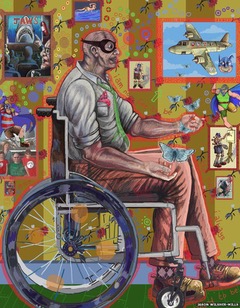
In 2015, to celebrate 800 years of Magna Carta, Parliament commissioned nine artists, three of whom are disabled, to produce banners for Westminster Hall. Jason Wilsher-Mills created banners inspired by the 1834 Tolpuddle Martyrs and the 1995 Disability Discrimination Act (DDA).

Jason Wilsher-Mills parliament banner.

Rachel Gadsden took the 1601 Poor Law and the 1829 Catholic Emancipation Act as her inspirations. Paula Stevens-Hoare marked The Great Reform Act of 1832, which extended the right to vote, and the 1967 Sexual Offences Act, which decriminalised homosexuality, with her banners.
The banners have now been gifted to different venues round the country. Jason Wilsher-Mill’s banner will be exhibited at The Art House in Wakefield later this year.
The final example of a powerful and moving banner that’s both protest and remembrance is the one created by Gill Thompson and Maggie Zolobajluk listing the names of people who have died due to benefit cuts and sanctions. Gill’s brother was David Clapson, an ex-soldier who died penniless and hungry following benefit sanctions (see short video). The banner was taken to the Government’s Dept for Work & Pensions headquarters earlier this year, along with a petition signed by 31,000 people, demanding changes to the sanctions policy. So far none have been made and the DWP continues to abdicate all responsibility for David and others’ deaths.

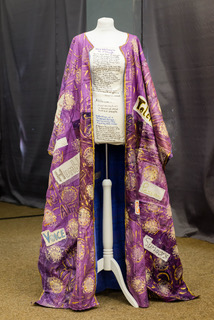
The work of one of the artists who featured in the Shoddy exhibition, Lesley Illingworth’s Story Telling Coat likewise remembers those who have died due to benefit cuts, pairing names of the deceased with Members of Parliament and warning that this is the ultimate price demanded from disabled people who are unable to comply with punishing work regimes.

Storytelling Coat by Lesley Illingworth. Photo: Mat Dale.
Storytelling Coat by Lesley Illingworth.
Photo: Mat Dale.

Recommended Citation:
Gill Crawshaw (2018): Banners of the UK Disabled People´s Movement. In: Public Disability History 3 (2018) 3.