October 29, 2018

People of short stature as representatives of the gods?

By Bert Gevaert, PhD

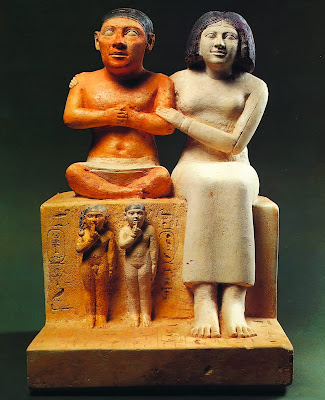
Seneb and his wife Senetites (ca. 2520 BC) (Egyptian Museum, Cairo)
Seneb and his wife Senetites (ca. 2520 BC)
(Egyptian Museum, Cairo)

People of (unusually) short stature1 are extremely popular in art: portrayal of people with so called ‘proportionate’ or ‘disproportionate’ short stature (usually achondroplasia) can be found all over the world and through the entire history of mankind. People of short stature were popular in ancient Roman and Greek art, but also in Asian, African and Latin American cultures. Fascinated by the tiny appearance of their fellow human beings, artists from Classical Antiquity till today liked to sculpt, cast, draw, paint, photograph or film people of short stature. Do these persons remind them (and us!) of ancient mythology about people of short stature living in faraway places? Do they attract us by their doll-like features? Are they funny, simply because they are smaller than ‘normal’ people? Some people consider them as more than funny, in their opinion they are ridiculous and for them they are a popular target to laugh with.

Without any doubt the Italian painter Faustino Bocchi (1652-1752) was one of history’s artists who was obsessed by people of short stature. Nevertheless, he is less famous than Diego Velázquez (1599-1660) who also made several beautiful paintings of the same subject (e.g. Las Meninas, 1653). Faustino Bocchi, who lived in Brescia, was specialized in painting people of short stature in ridiculous poses and situations. These paintings caused great amusement amongst his clients and made Bocchi a wealthy person. His tour de force, which was actually a shameless imitation of the works of Giuseppe Arcimboldo (1526/7-1593), is without any doubt the portrait of a human face, consisting of grotesque ‘pygmies’.

Faustino Bocchi, A Head formed out of Pygmies (1729) (Christie’s Images/Corbis)
Faustino Bocchi, A Head formed out of Pygmies (1729)
(Christie’s Images/Corbis)

Today, looking at this painting, we can nod our head and condemn this painting of Bocchi, naming it ‘disrespectful’ towards a minority group, which is certainly a right attitude. On the other hand, Bocchi’s depiction of little people is only an exaggerated version of all other depictions of people with short stature in art around the world and throughout history. Almost always these people are portrayed with an emphasis on their tiny stature: they are shown with furniture, their protectors or benefactors (adult men and women or even children), various kinds of animals (parrots, dogs, monkeys,…) which make the contrast between big (normal?) and small even bigger. The animals on paintings with people of short stature seem to suggest that they were seen as nothing else than another kind of pet, meant to amuse their masters. 

To my knowledge, there are almost no paintings or sculptures of people of short stature in a normal environment, where their size doesn’t matter. Almost always they are represented in art as utterly little, incredibly cute, unbelievably ugly, mysteriously strange or hilariously ridiculous. It seems like they don’t have no other function than to please and divert other people. Do they have a life outside of the painting? Do they have a wife? Do they have kids? Are they more than just people who are smaller than ‘normal’ people? 

In that respect, the sculpture of Seneb and his wife Senetites, made by an unknown Egyptian artist around 2520 BC, is a unique depiction of a person of short stature. Seneb is portrayed in a very respectful manner, with his wife and children. Seneb is seated on the same height as his wife and because he crosses his legs while sitting, it can’t be seen, at first sight, that he is smaller than his wife. In this way, both are on ‘the same level’: they are equal in height and this might suggest a harmonious marriage as well. She is a beautiful woman and puts her arm around her husband in a  very tender and loving way. The danger that the harmony – on the level of art and life -  between this Egyptian man and his wife could be disturbed by the little legs of the husband, is avoided in a very intelligent way. The artist has replaced Seneb’s legs by two of the children of the couple, a boy and a girl. Seneb’s children serve as the legs of their father, but they are also the symbol of a successful marriage.

Seneb was a proud man, enjoying a happy life as a father, but also as a personal friend of the pharaoh. In the tomb of Seneb (near Cairo) about twenty of his royal titles can be found: friend of the Pharaoh, overseer of the dwarfs, overseer of the royal ships, overseer of the animal tenders, keeper of the seal of the gods,… Besides that Seneb and his wife were both important priests.

Why did Seneb obtain this prestigious position and why – as a consequence – was he depicted in the most respectful matter a person of short stature has ever been in history? Ancient Egyptians were very kind towards mentally and physically challenged people, but amongst them, people of short stature were the most respected. In ancient Egypt, at least two gods were venerated who had small stature: Bes and Ptah Pataikos. Bes was the god who protected women against evil, especially when they delivered babies. Ptah Pataikos, on the other side, was connected to Ptah, who was god of craftsmen and architects. Thus, both were very important gods.

Bes (3th-1st century BC) (Carlsberg Glyptotek, Copenhagen)
Bes (3th-1st century BC)
(Carlsberg Glyptotek, Copenhagen)
Ptah-Pataikos (Late Period, 712-332 BC)
(Carslberg Glytotek, Copenhagen)

In their appearance, Bes and Ptah-Pataikos show typical characteristics of what is medically phrased as ‘achondroplasia’, the most common form of short stature. People of short stature, who are said to have achondroplasia, usually have a torso with ‘normal’ size, disproportionate small limbs with slightly curved legs and a large (fore)head. All these characteristics are prominently depicted in Ptah-Pataikos and Bes.

People of short stature reminded the ancient Egyptians about the scarab or Sacred scarab (scarabaeus sacer), a species of dung beetle which has a normal sized torso and tiny, disproportionate and curved limbs. This insect makes small balls of dung which he rolls out or towards his hiding place. This movement of rolling a ball out of a hiding place, reminded the ancient Egyptians about the movement of the rolling ball of the sun. In the eyes of the ancient Egyptians, people of short stature were not suffering from a physical challenge, but they were representatives of the gods here on earth. In this way, they deserved the highest respect!

Bert Gevaert obtained a PhD on the representations of disabilities in the epigrams of the Roman author Marcus Valerius Martialis (40-104 AD) (Free University of Brussels, 2013).
[1] For this text I preferred to use the term ‘people of short stature’ instead of other (combinations of) words, e.g. ‘little people’, ‘short people’, ‘small people’ or worse… ‘dwarf’. Though dwarfism refers to the medical condition of being unusually smaller than average (https://www.lpaonline.org/faq-) and some people of short stature have no problems with the word ‘dwarf’, the term ‘people (or person) of short stature’ is less biased and less insulting.

______________ 
Recommended Citation:
Bert Gevaert (2018): People of short stature as representatives of the gods?. In: Public Disability History 3 (2018) 12.


October 5, 2018

“Just like everyone else”: Studying constructions of ‘normality’ through attitudes towards conjoined twins

By Helena Franzén, Uppsala University

In 1996, the American conjoined twins Abigail and Brittany Hensel went on the Oprah Show and spoke about their daily lives and their wish to impress upon the viewers how they both were quite ordinary people. Documentaries followed and they got their own reality show at TLC. In the show, the audience could follow their everyday life; at home, in school, and when doing extracurricular activities such as taking their respective driver’s licences. The viewers were also allowed to access the twins’ hopes, dreams, and plans for the future. Abigail and Brittany portrayed themselves as having two quite different personalities and expectations on life, and went on air to counter preconceptions about conjoined twins. By showing the public how normal they actually were, they wanted to demystify the condition. They were two young girls who wanted to raise awareness and be treated as the regular persons they were. The Youtube clip below shows one of the first documentaries about the twins. The strongest message is that Abigail and Brittany indeed are just the same ‘as everyone else’, a few physicians flash by. Even though they themselves stress that they respect the wishes of the twins and their family to not conduct more advanced medical investigations than regular check-ups, the strong curiosity still shines through.

YouTube video titled "Abigail & Brittany Hensel - The Twins Who Share a Body"

Conjoined twins have been a topic of interest in medicine for many centuries. Physicians have for example debated whether these bodies were the vessels of one or two souls, as well as pondered why and when this condition happens during pregnancy. In my research, I examine the social processes of collecting bodies for medical science in nineteenth-century Sweden. More specifically, I am interested in why and how the bodies of embryos and fetuses, of which many were conjoined twins, were obtained, transformed into scientific objects, and put on a shelf in a medical collection. An aspect of this is the social construction of ‘normality’ and ‘pathology’, as well as who set the boundaries. How were conjoined twins understood in the Swedish society at the time? To contrast definitions set by the medical community, media representations is a way to start unpacking notions about how people with this kind of body were regarded by society and how they understood themselves. This is important when attempting an analysis of the dynamics of collecting practices.

Throughout the second half of the 19th century, there were short reports in the Stockholm-based daily newspaper Dagens Nyheter of ‘siamese twins’ born in other parts of the country and several adverts about touring so called ‘freak shows’, especially international ones. Among these were short reports about Chang and Eng Bunker, the original ‘siamese twins’. They were born 1811 in Siam, today’s Thailand, and after years of touring the world as a sideshow attraction, they settled in the USA. The Bunkers became famous both at home and on the European continent. They both married, had children and became homeowners and farmers, spending alternating nights in their respective homes. Chang and Eng themselves cultivated their individuality, marking their difference through property and social relations. They travelled the world and performed in front of an audience, putting themselves on display as a mean to earn an income. This was their way of making a living, by directing the audience’s gaze towards their extraordinary bodies. Yet their private lives were aligned with expectations on contemporary well-off middle-aged men. The fact that each had a family and a household to provide, leading such ordinary lives became part of the narrative of wonder.[1]

A black-and-white studio portrait of Chang and Eng Bunker, two middle-aged men with stern faces, joined at the abdomen, wearing suits.
Public Domain, https://commons.wikimedia.org/w/index.php?curid=2330999

This raises questions about the construction and borders of normality, what does it mean to have a normal life? In the cases of the Bunker- and Hensel twins, normality is imagined as a way to participate in society and thus performed accordingly. Attention is centred at, yet drawn away from the shape of their bodies and instead directed onto what kind of activities they can do and which kinds of lives they can lead. In my research, I encounter only fragments of information about Swedish conjoined twins outside the medical sphere, most often filtered through the accounts of medical practitioners. Since my point of departure is anatomical collections as a mean to trace practices and attitudes, it is specimen jars on display in museums and used for research which dominates my field of view. They are produced in the context of medicine and mediates a specific narrative of what normal and deviant bodies are. I aim to look beyond these images and to include the agency of positions outside medicine in order to gain a more nuanced analysis.

One of the problems I face in trying to understand the shaping and negotiation of normality in my period and place of time is that it is very difficult to locate sources containing the voices of conjoined twins themselves, or the ones of their families. The easiest voices to find are the ones of scientists and medical practitioners, and I am worried that I will slip into the trap of reproducing only the narrative presented by them. Thus, framing the collected bodies as raw material for research and reproduce exoticism, as well as cement ideas about what constitutes ‘a normal body’. This struggle resonates with the one faced by Rana Hogarth, who in a previous blog post wrote about the issues of researching the history of slavery and how to tackle the asymmetry of records. What did it mean to give birth to conjoined twins, what were the consequences if they died, or survived, and which were the implications for the negotiation between the parents of deceased conjoined twins and the medical practitioners who wanted to collected the bodies for scientific purposes? These are questions I am hoping to be able to address and I consider disability research to be a powerful tool to steer the gaze away from the stories told by medical men, who had their own specific agendas, and instead ask what the lived experiences of conjoined twins themselves and those of their families were.

Since there is a scarcity of records of this, one way around is to look at how conjoined twins were portrayed in the media at the time (the Bunker-twins being the most famous example), as a way to raise new research questions which might direct me to source materials I’ve previously not thought of and a mean to reconfigure the framework. Another way is to aim for self-reflexivity and challenge my own subconscious preconceptions by watching stories told by conjoined twins in my own time, such as the Hensel-twins. There is a lot of power of in the choice of perspective and thus it is vital to shift back and forth between more than one during the research process, as well as being transparent in what kinds of choices we as historians make when writing history.

Helena Franzén is a PhD student within the project Medicine at the borders of life: Foetal research and the emergence of Ethical Controversy in Sweden, funded by the Swedish Research Council Dnr 446– 2014–1749. See http://medicalborders.se.

__________
Recommended Citation:
Helena Franzén (2018): “Just like everyone else”: Studying constructions of ‘normality’ through attitudes towards conjoined twins. In: Public Disability History 3 (2018) 11.

August 15, 2018

Eating Dirt, Treating Slaves

By Rana Hogarth

Historians of slavery must often contend with how the power imbalances of the slave system continue to shape the archival record, and, more importantly, influence the types of stories that get told. I certainly found this to be the case when writing my first book, Medicalizing Blackness: Making Racial Difference in the Atlantic World, 1780-1840 (University of North Carolina Press 2017). I felt overwhelmed as I weighed the written correspondence, published medical treatises, military records, and plantation records, medical lectures etc. by white physicians, military officers, colonial elites, and slave owners, against the dearth of written sources left behind by enslaved and free black people. Thus, it was a great challenge to construct a narrative using sources whose faithfulness in accounting for black people’s experiences in sickness and health were tenuous to say the least.

Given the realities of the archives related to slavery, my approach to research became informed by working with the asymmetries in my evidentiary sources rather than against them. Part of what I hoped to achieve with my book then, was to not only show how blackness formed a corpus of knowledge that white physicians used to cultivate their medical authority and professional expertise, but also to show how enslaved people shaped this often contradictory and protean process. I tried to amplify the experiences of enslaved people as recipients of white medical treatment and as objects of white medical gazes, rather than “speak” for them. I reminded myself as I wrote the book that the doctor-(subjugated) patient relationship was a two-way street—one in which the balance of power was in flux. Physicians had to read patients’ bodies for clues and inquire about symptoms; slaves could dissemble, lie, or even be forthcoming when they described their symptoms. Physicians could also ignore slaves’ symptoms if they did not fit their expectations of how a slave’s body should respond in times of sickness, and, in some cases, physicians simply failed to understand the meaning of their patients’ symptoms.  Bearing all of this in mind, I thought about why white physicians presented the information about black people’s bodies in the way that they did. What was at stake for these physicians? And how did a physicians’ pronouncement that enslaved person was diseased help create a new identity for that slave in the plantation economy and community?

Heads circa 1836 Richard Bridgens


I applied this line of questioning in my book’s chapters on Cachexia Africana—a little known slave disease that only affected black people. It was typically attended by dirt eating and a gradual wasting away of the body. Cachexia Africana was a creation of the collective white imagination; it was a pathology only found in black people, hence the name Cachexia Africana or “African wasting.” Doctors no longer use the label nowadays, but it appeared in medical texts during the era of slavery. Dirt eating, however, could apply to anyone of any race, and has been known as pica or geophagy. Generally speaking, Cachexia Africana often appears as a footnote or a brief reference in many scholarly works on slave health.  Some scholars have pointed out that Cachexia Africana was just one of many socially constructed slave diseases. Others have used this disease as means to highlight the nutritional deficiencies that plagued enslaved black people’s bodies.

In Medicalizing Blackness, I used Cachexia Africana to illuminate how enslaved people challenged white physicians’ authority.  Moreover, I also used the disease to show how white conceptions of what was normal versus pathological in black people’s bodies was deeply contingent on context and largely socially constructed. Throughout this process I used the very discourses that white physicians had generated about the alleged physiological deficiencies in black people—the very sources that seemed to replicate the power of slavery in the archive.  I took the approach of scrutinizing what it was that white physicians said (or didn’t say) about Cachexia Africana and its victims in medical texts. For example, many physicians complained about treating slaves who fell victim to Cachexia Africana more so than other common diseases they encountered. Most physicians who wrote about Cachexia Africana did so in treatises or dissertations dedicated to “negro diseases” or plantation medicine, and they lost no time boasting of their medical skill (many of the physicians who wrote about the prevalence of this disease on Jamaican plantations studied at renowned medical schools such as the University of Edinburgh). When these physicians failed to treat Cachexia Africana, why did they spend so much time complaining about it—thereby drawing attention to their professional shortcomings? What did their failures say about the limitations of white medical knowledge and education in the disease environments of the Caribbean? For physicians that blamed enslaved spiritual healers for bringing on the disease or exacerbating it, was this a way for them to excuse their inabilities to affect cures? (Physicians did not mince words when it came to complaining about enslaved practitioners!) Enslaved practitioners likely enjoyed more trust and respect within the enslaved communities in which they practiced than white physicians. Bearing this in mind might explain why white physicians felt that they were being undermined as they tried to treat Cachexia Africana. Indeed, European physicians who practiced in slave societies acknowledged that enslaved healers simply had more effective treatments than what Western medicine could offer—a topic expertly examined by Londa Schiebinger’s Secret Cures of Slaves: People, Plants, and Medicine in the Eighteenth-Century Atlantic World. We can perhaps surmise then, that white physicians who attempted to treat Cachexia Africana were irritated by competition from enslaved healers and hemmed in by ineffective treatments.

Finally, textual descriptions of the symptoms of Cachexia Africana made legible the ways white physicians imposed concepts of normalcy or pathology on enslaved people’s bodies—a practice that might perhaps be familiar to scholars interested in disability studies.  Cachexia Africana curtailed slaves’ ability to labor, and slaves that were unable to labor were viewed as suffering from some kind of pathology (hardly ever overwork). In a sense, Cachexia Africana, served the purpose of reinforcing narratives that equated a slave’s ability to labor with normalcy. Here I would add, that due to the extreme deprivation and exposure to unsanitary conditions that slaves endured on the Middle Passage, and the plantation, the bodily fitness which slave owners and overseers desired in slaves appears to be more aspirational than real. Similarly, we might consider what other definitions of fitness that have appeared across time worked as social constructs to satisfy idealized rather than real ideas about health. Re-examining how concepts of pathological versus normal traits emerged through writings about diseases generate new questions to ask of our archive and historical actors regardless of area of interest. In sum, recovering the experiences of marginalized groups often involves interrogating what they did or did not do in the face of oppressive medical authorities; noticing how and why their very bodies could create such contempt for those who wrote about them.


Rana Hogarth is assistant professor of history at the University of Illinois, Urbana-Champaign. 

Recommended Citation:
Rana Hogarth (2018): Eating Dirt, Treating Slaves. In: Public Disability History 3 (2018) 10.

June 19, 2018

Blinde und Kunst celebrates its 25th anniversary

By Siegfried Saerberg

I. Darkness as the womb of “Blinde und Kunst e.V.” (BuK)1

In the year 2018 the association “Blinde und Kunst” [BuK] - blind people and the arts - celebrates its 25th anniversary. BuK was founded in 1993 in Cologne as a nonprofit organization of blind, visually impaired and sighted artists, as well as blind or visually impaired people who are interested in the arts.

Audio:
Leslie Ann Hewitt sings “Lilac Wine”, recorded 2013 in Cologne

© Blinde & Kunst.

BuK includes musicians, composers, writers, actors, sculptors and those who are just interested in culturally [de]constructing/presenting blindness in a new way. Its rise coincided with and inspired the beginning of the “darkness-movement” in Germany. By this term I mean activities such as “dialogue in the dark” and several dark restaurants and cafés presented and organized by blind people.2 Thus, guiding sighted people into the dark in order to get on equal terms with them was our initial aim.

We developed a dark show which we called “Black Out” including music, dance, theatre-play, literature, stand-up comedy and magic.

Audio:
Niko Valentino presents his dark magic show, recorded 1996 in Hamburg
© Blinde & Kunst.

[DescriptionYou hear music from a violin and a guitar. Then Niko exclaims: “Good evening, I am the magician with the pony tail. I have dressed up for you – but I am not sure whether you have already realized this.”]

The dark show also contained everyday activities such as finding one’s seat, finding the washroom and the exit, ordering a drink and paying in an entirely dark social situation. In 1993 for the first time “Black Out” celebrated blindness together with sighted guests and blind and sighted artists in a little theatre in Hamburg called “foolsgarden”. By 2007, “Black out” had been hosted at more than 100 events all over Germany, Belgium and Austria.

II. Producing radio programs and exploring blind culture

In 1995, BuK started to produce an acoustic magazine first on cassette and then on CD that was only distributed among its members. It contained more than 30 samples with around 35 copies which were sent via mail to each member. Between 1997 and 2000, we worked together with a broadcasting company in the south-west part of Germany [SWR] with the idea of presenting radio plays in darkness. A radio play called “Café Finsternis” resulted from this project.

Audio:
Tommy Ahrens and his guide dog Kelly singing the blues, recorded 1997 in Freiburg.
© Blinde & Kunst.

[DescriptionTommy talks to his dog Kelly, then he plays the harp, Kelly sings.]

In 2004, we started to produce radio programs on our own and we still do this today in a local radio station in Cologne called “Freier Bürgerfunk”. From 2010 to 2012, together with “Radiofabrik” in Salzburg [Austria] we took part in a European culture program called “Ohrenblicke” [Ear Glances] to develop our technical and journalistic skills. Such radio programs are intended to present elements of blind culture to a wider public.

III. BuK explores blind arts

Our next goal was to develop special expressions of art that could be appreciated in the dark in order to make it more accessible for blind and visually disabled people. Between 1995 and 1997, BuK conceptualized three exhibitions in total darkness in Bergisch-Gladbach, Hamburg and Cologne, together with local associations of artists and the local association of blind and visually impaired people. The exhibition was called “Sinnenfinsternis” [eclipse of the senses] which is a play on words of the German phrase “Sonnenfinsternis” [eclipse of the sun] – with a forthcoming cosmic event on 11th August 1999. Acoustic, tactual, olfactory and gustatory exhibits – and also ostensibly visual ones such as a colour-cabinet for the haptic sensation of colour – were presented in total darkness to a mostly sighted audience.

In 2010, BuK developed the exhibition “Blinde Flecken” [Blind Spots]. The exhibition featured 17 favourite places of blind or visually impaired narrators. Voices, sounds and other audible sources were tape recorded to create an auditory portrait. Visitors could listen to these voices and sounds in dark booths via headphones. These recorded sounds were also presented on CD. 

Audio:
“3541 Miles” by Robbie Sandberg, published 2011.
© Blinde & Kunst.

[Description: You can hear a lot of different sounds. Then the author asks, what it is that drives a blind backpacker away from home. He answers that it is just the same thing that leads all backpackers into the world: To discover new things experience other people and different cultures and the lust for adventure. “Every city, every region has its own impact on the senses”, he says. Now you can hear several sounds of public travel like London Underground, San Francisco Cable Cars or Hamburg S-Bahn. Then you can hear a soundscape from India. The author concludes: “To experience with my own ears a sound that you normally only hear by watching an animal film tells me how far I am away from home”.]

In 2013, we transferred our concepts from dark environments to a lighted context now focusing on art exclusively produced by blind or visually impaired artists. Every work of art could be touched, was audio-described and a guiding system led through the exhibition.

Photo:
“Tapestry I”. Fire screen, cutlery, gardening tools, 2012 by Marian Edwards for the exhibition “Art Blind” (17.5.2013 – 17.6.2013) im Stapelhaus, Cologne.

Photo: Victor Dahmen, © Blinde & Kunst 2013
[Description: The object is a Victorian fire screen, an article of daily use which is placed in front of an open fireplace to prevent sparks from flying into the room. Fixed to its surface are carelessly discarded gardening tools and rusty, tarnished, dented, and bent cutlery. The objects are arranged in a very symmetric pattern both next to and on top of each other. We find scissors, fish knives, a small rake, and a little shovel. Tea and tablespoons of different sizes are placed in a row. With two exceptions, their handles point upwards and their inner surfaces face us.
Those are items which remain behind when a house is emptied out or when the attic is cleaned. They are the remains which remind us of a bygone life.
The artist writes, "I am fascinated by the way the light falls onto these objects and how the colours of the tarnished silver and discarded metal change. How we deal with objects and how we combine losses and memories that way."]

These exhibitions attempt to conceptionalize art and exhibitions beyond the limitations of the eye. They are also examples of the ways in which art exhibitions, from their initial conception, can be designed to accommodate the cognitive and perceptual culture of blind and visually impaired people. And moreover, they also represent a new and different experience for sighted people as well: the beheld object is not necessarily a visual one. It might also be an acoustic, tactual or gustatory one. So beauty does not only lie in the eye of the beholder. It also lies in the cognitive, perceptive and habitual procedures of the beholder’s body and mind.

IV. Conquering the citadels of art

From 2015 to 2017, we worked together with four major museums in Germany in a project called “Pilot Inklusion”. Together with Bundeskunsthalle in Bonn we worked on three exhibitions: “Japans Liebe zum Impressionismus” discussing the relationship between European impressionism and traditional art in Japan; “Pina Bausch und das Tanztheater” exploring the work of this extraordinary German choreographer from a bodily perspective, and “Wetterbericht”, dealing with the very subjective experience of weather as well as with global climatic changes. Besides implementing many tools to make the exhibitions accessible we presented works of art created by people with disabilities as a part of the exhibition.

Photo:
“Wolken, Textile, 2017 by Michael Gerdsmann, Die Schlumper (Hamburg) for the exhibition "Wetterbericht. Über Klimakultur und Klimawissenschaft" (7.10.2017 - 4.3.2018) in Kunst- und Ausstellungshalle der Bundesrepublik Deutschland, Bonn.
Photo: David Ertl © Kunst- und Ausstellungshalle der Bundesrepublik Deutschland, Bonn

[Description: You can see a woman touching some crocheted clouds hanging in the air. The clouds are in different sizes and made out of wool. They vary in colour between white and black. Behind the woman you see her guide dog laying on the exhibition floor.]

Photo:
“Welle im Auslauf” by Karla Faßbender for the exhibition "Wetterbericht. Über Klimakultur und Klimawissenschaft" (7.10.2017 - 4.3.2018) in Kunst- und Ausstellungshalle der Bundesrepublik Deutschland, Bonn.
Photo: © Blinde & Kunst.

[Description: You can see a wave made out of alabaster. It is rather a smooth and soft wave than a big one. It feels like you lay your hand on the watery surface of the Northern Sea on a very calm morning.]

We also worked together with “KUNSTHAUS KAT18” in Cologne where many artists with learning disabilities produce their works. Widening our scope from blindness to disability in general, the project dealt with three major topics concerning the relationship between culture, arts and disability:
  • Accessibility: All arts must be made accessible to disabled people. Not a single kind of art may be excluded. This needs to be done in a process of transformation.
  • Multisensory [Tactile, acoustic and audio-descriptive] elements must be implemented
  • The permission to touch original sculptures
  • The availability of copies that are as close to the original in form, material and size
  • Multi-cognitive strategies [simple language, diverse languages] must be applied
  • Special guide services and guide systems should be available
  • Professionalization so that disabled co-workers will be hired in museum-contexts as volunteer work may not be the appropriate basis
  • Inclusion: The process of transformation should involve the communication of at least three groups: people with disabilities who should be the subject of transformation, the museum experts who know about the objects and their cultural context, and disabled artists who are best-equipped to encapsulate this process of transformation. This communication must be instituted within local, regional and national organisations: Every museum, every centre of arts should create a council to work together with groups and organizations within the disability community where this process of transformation can take place.
  • Participation: art and culture in a broader social context should be embedded into the work of disabled artists. The artistic and cultural expression of disabled people should be encouraged, promoted and supported. And because these belong to human heritage, it must be made accessible for the whole of society in museums and galleries.

Accessibility, inclusion and participation should not be added to exhibitions in a second or third remove, but seen as an inclusive making of culture in general. Disability approaches should be embedded already in the first steps of conceptualisation. This also means, that exhibitions should represent disabled people, their arts and their culture. This is, because it is society which makes people disabled. So it is also society which can enable us again. Furthermore, society is also obliged to do so, because society is the overriding factor which enables or disables all human beings in the first place. We are social beings with our own unique culture which yearns to be represented among other cultures in public places such as museums, theatres and galleries. And we as members, producers and recipients of disability culture and disability arts should in the future be able to make our presence felt in mainstream culture and the arts.


Website:
www.blindeundkunst.de


[1] I like to thank Leslie Ann Hewitt and Luke Hewitt for supporting the translation from German to English. Thanks also go to Eckhard Seltmann.
[2] Siegfried Saerberg [2007]: The dining in the dark phenomenon. In: Disability Studies Quarterly, vol 27 no 3, summer 2007. http://dsq-sds.org/article/view/24/24


Recommended Citation:
Siegfried Saerberg (2018): Blinde und Kunst celebrates its 25th anniversary. In: Public Disability History 3 (2018) 9.

May 21, 2018

A Source Edition of the History of People with Disabilities in Germany after 1945. A contribution to Public Disability History

By Raphael Rössel and Bertold Scharf

The list of complaints was long: Inadequate teaching facilities, lack of resident participation, arbitrary distribution of premium payments by the institution’s administration and forced residence in the institutional facilities during job training programs. In the early 1970s, the Bremen rehabilitative institution Friedehorst came under severe criticism by various disability advocate groups and youth clubs.1 To indicate the extent of the misconduct to local politicians, the journalist Gerhard Tersteegen compiled a compendium of the institutional transgressions. His documentation, entitled Heimideologie contra Integration [Institutional ideology versus integration], is only one of the previously unpublished sources featured in Quellen zur Geschichte von Menschen mit Behinderungen (QGMB) that documents the changing cultural realities of people with disabilities in Modern Germany and unearths their constant claims to agency.

QGMB follows the lead of various other disability historians to open the disability archive and eliminate barriers to explore the history of people with disabilities. Whereas American efforts already culminated in a digital disability museum as early as 2000 and other pioneering source platforms have made published journals of the German disability movement (Krüppelbewegung)2 available, unpublished primary material that offers glimpses into the intricate realities of people with disabilities have remained unavailable for larger audiences in Germany – or reserved for the privileged eyes of historians. QGMB attempts to further open the archive for a general audience.

Additionally, to help integrate disability history into mainstream educational curricula, the source
edition is didactically designed for use in both high schools and universities.3 Apart from a search function, the categorization of sources reflects different facets of the phenomena collectively referred to as Behinderung. Even more, the selected material and its encoding permit teachers to give students independent research tasks. As the documents are chosen to offer a variety of viewpoints on a given topic, and balance each other rather than require to be used as a unit, different levels of depth can be achieved according to the teachers, students and curricular demands. To fulfill the demand for multiperspectivity in history didactics, both non-disabled commentators and individuals categorized as disabled are collected in the source edition. Lecturers and high school teacher can select the amount of sources and which viewpoints to look at, and also whether to use the finely encoded sources in more independent or supervised teaching formats.

The project is initially derived from research project People with Disabilities in Germany after 1945. Self-determination and participation in two German states in comparative perspective. A contribution to Disability History that was funded by the German Research Foundation and headed by Gabriele Lingelbach at Kiel University. While the project was finalized at the end of 2017, QGMB assembles the project’s findings as a central archive. However, it is not only a testimony to the individual dissertations by Jan Stoll (Disability Self-advocacy movements in West Germany),4 Sebastian Schlund (West German Parasports),5 Bertold Scharf (Working environments of people with disabilities in the GDR)6 that makes their results available and sets the stage for new disability history projects in Kiel. While the sources are currently categorized according the domains of activism, sports, work, alongside legal texts and stereotypes, the source edition is devised to be enlarged – in categories, periods and territories.

Screenshot of the QGMB website.
Screenshot of the QGMB web site.

Particular attention was paid to long-term availability, searchability and intertextual relations. The documents were encoded with the standard for digital editions in the humanities - TEI. TEI allows not only to mark up the structure of the text but also textual elements like persons, places etc., so they can be directly identified. The faceted search on the web site works like a register and allows cross-referencing of persons, institutions, organizations, key words, places and laws. Each of these is referenced – if possible – with a permanent link to the respective entry in the German national library (DNB). Moreover, in contrast to a printed source edition, it is possible to extend the edition in the future. The usage of TEI also facilities upcoming research: In TEI, different terminologies for disabilities and people with disabilities are indicated and could serve as a foundation for a corpus that helps to uncover discursive changes in the naming and, hence, in the construction, ascription and disavowal of the complex of dis/ability. These encoded concepts include the GDR’s Geschädigte [damaged/defective], the male veterans’ self-description of Versehrte [permanently wounded] and the Sorgenkinder [problem children] that became a frequent reference point after the Thalidomide scandal in early 1960s West Germany. The encoding makes the documents not only machine-readable and searchable, but also qualified with meta-data (bibliographical information, key words and notes on the edition process and responsibilities). The documents will be published in the TextGrid Repository, a digital preservation archive for XML/TEI encoded humanities research data, so the documents will be available also if the web version site should not exist anymore.

The web site is barrier-free and accessible for blind and visually impaired people: It is readable for a screen reader and every picture is linked with an alternative description. Unfortunately, it is not accessible to non-German-speaking people and people with learning difficulties, there is no English version and the texts are not translated in easy-to-understand language.

In its current inception phase, QGMB comprises 37 very diverse sources.  From complaints about institutional repression, such as Heimideologie contra Integration, to leaflets written by the German disability movement, to parasport visuals that speak to the changing cultural ascriptions of mental or physical dis/ability. Moreover, the range is from letters of complaint directed at federal ministries, official advertisements for the Kriegsversehrtenspiele to satirical obituaries of the disability movement for the public service TV lottery Aktion Sorgenkind which was often regarded as paternalistic. Newspaper articles show how the subject was discussed in the public and abstracts from laws and regulations show the handling in politics. Each individual source is amended with a separate commentary by the disability historians of the Kiel project. These commentaries frame the source and reference further research on the topic.

Poster for the 3. Deutsches Versehrtensportfest [3rd German tournament for permanently wounded veterans] on the German island of Sylt. This ad depicts an athletic swimmer joyously waving his arms. The impaired part of his body, however, remains unseen and below the waves of the North Sea.

We hope that we have created a helpful resource for teachers and students to learn more about disability history and provided encouragement to do more in this field. Hopefully, the source edition will only be the beginning of a process.


1 Cf. Lingelbach, G. / Stoll, J. (2013): „Die 1970er Jahre als Umbruchsphase der bundesrepublikanischen disability history? Eine Mikrostudie zu Selbstadvokation und Anstaltskritik Jugendlicher mit Behinderung.“ In: Moving the Social 50, S. 25-52.
2 Lux, U. (2017): "Nothing is forgotten, and nobody!" Archives for the disability rights movement as a disability policy project. In: Public Disability History 2 (2017) 19.
3 Hellberg, F. (ed.) (2016): Disability History: Behinderung in der Geschichte - ein Längsschnitt. Aachen: Bergmoser + Höller.
4 Stoll, J. (2017): Behinderte Anerkennung? : Interessenorganisationen von Menschen mit Behinderungen in Westdeutschland seit 1945. Frankfurt am Main: Campus.
5 Schlund, S. (2017): "Behinderung" überwinden? Organisierter Behindertensport in der Bundesrepublik Deutschland (1950-1990). Frankfurt am Main: Campus.
6 Bertold Scharf’s forthcoming dissertation project is scheduled for release in the same monograph series on Disability History issued by Campus.


Recommended Citation:
Raphael Rössel/ Bertold Scharf (2018): A Source Edition of the History of People with Disabilities in Germany after 1945. A contribution to Public Disability History. In: Public Disability History 3 (2018) 8.

May 7, 2018

The Paris Banquet and the Swedish Deaf Movement, or: A Signed Room on Stage

By Jenny Schöldt
Translated by Ylva Söderfeldt

On May 3, 1868, a group of Deaf gathered together with a few hearing friends – today, we would probably call them ”allies” – at the Manilla Deaf-Mute Institute in Stockholm. The three initiators were the school’s hearing director Ossian Borg, the Deaf teacher Fritjof Carlbom from Tysta Skolan (“The Silent School”, another Stockholm Deaf school), and the artist Albert Berg. Carlbom had paid a visit to Berlin and, inspired by the Deaf club there, had decided to start something similar in Sweden. On this day, twenty-two Deaf and five hearing persons agreed to form the Deaf-Mute Society, Dövstumföreningen, predecessor of today’s Swedish Deaf Association. This remarkable event, a milestone in Swedish Deaf history, celebrates its 150th anniversary this month.

It was the actor Joakim Hagelin-Adeby, chairman of the Stockholm Deaf Society, who came up with the idea to stage a play in honor of the history of the Swedish Deaf movement and the banquets that were held in Paris in the 19th century to celebrate Sign Language. The title was going to be Parismiddagen – the Paris Banquet. His suggestion prompted Tyst Teater, a theatre company that has been performing in Sign Language for more than four decades, an audition for Deaf writers. The framework was in place, and now prospective playwrights were free to be creative.
When I found out about the idea, I immediately envisioned a table in a room, with two Deaf persons seated, signing: artfully, quickly, humorously, like I’ve seen my Deaf friends sit and sign so many times before, and like I’ve done myself. I often think of Sign Language as something that goes on in the room where it is ”spoken”, that can’t be translated or captured. Sign Language is a language without tenses, consisting, put simply, of lexical and non-lexical signs. The non-lexical signs are descriptive verbs that are modified (signs are not inflected) according to context, or created as a result of the syntax. Very much like what happens on a theatre stage.
To write a script in one language that is supposed to be performed in another one, because the latter lacks a written form, is a problem that has been discussed over and over again within Tyst Teater and the rest of the Deaf artistic community.  In the past, for a different project, I had tried writing in a modified Swedish that made it clear how the lines were supposed to be signed. But this solution killed the creativity of the actors, and impeded the artistic work of the director.
I realized that I can’t decide how another Deaf person has to express themselves.
That has to happen in the room. In the conversation.

Actors Joakim Hagelin Adeby and Mette Marqvardsen on stage, seated across from each other at a long table set for a banquet, dressed in historical costumes and signing. Photographer: Urban Jörén
Actors Joakim Hagelin Adeby and Mette Marqvardsen on stage, seated across from each other at a long table set for a banquet, dressed in historical costumes and signing. Photographer: Urban Jörén

So this is why I wrote the play in Swedish. I was fortunate to know the previous work of the director, and to some extent the style and skills of the actors. The fact that they had to work with translation and interpretation gave the piece a dimension I now find invaluable.
Writing a play about a movement that is still ongoing, as a person who is part of that movement, is a strange and exhilirating meta-emotion, and perhaps something historians can relate to. A piece of history, alive, that I am observing and part of creating. Myself, and other Deaf. This was my intellectual starting point. I wanted to use my perspective on Deaf history, as it appears when I ask myself the question: what is Deaf history? Milestones such as the French signed education, the deaf schools, the official acknowledgement of Swedish Sign Language by the state in 1981, the Swedish Deaf movement. I want to be clear that I am concerned here with Nordic Deaf history, with a few links to other European Deaf communities and the US.

One table. Two signers. Leaping from one milestone to the other.

Actors Mette Marqvardsen and Joakim Hagelin Adeby on stage, Marqvardsen with a pipe, Hagelin Adeby with glasses, shaking hands and cheering. Photographer: Urban Jörén

Then I started reading and exploring, somewhat, these milestones. I soon found myself annoyed at how most of the documented history of the Deaf dealt with the schools, or consisted of dull summaries of club proceedings and such. This gave me reason to reflect on why this is what the sources look like, questions that I incorporated in the piece. In this manner, I brought myself onstage, and I hoped that the audience would be able to identify with my experience, even if their questions weren’t exactly the same. Speaking of documentation, we are among the peoples that lack historical records, since we didn’t have written language, and since we are not born into our group. We are born into another linguistic community, and grow up among the hearing. In order to sign, we need other Deaf people. An somehow, we always seek out and find each other, and somehow Sign Language always finds us.

Actors Joakim Hagelin Adeby and Mette Marqvardsen on stage, standing behind the table holding up a banner that reads, in Swedish: "TO BE. DEAF. SIGN LANGUAGE FOR ALL." Photographer: Urban Jörén

Words come and go, but the Deaf are here to stay.

Parismiddagen is currently on tour in Sweden. Some of the performances are accompanied by seminars on Deaf culture and history. See https://tystteater.riksteatern.se/parismiddagen/


Recommended Citation:
Jenny Schöldt: The Paris Banquet and the Swedish Deaf Movement, or: A Signed Room on Stage. In: Public Disability History 3 (2018) 7.

April 20, 2018

I Am an Independent Blind Historian

By Alida Boorn, PhD

Although I have been blind for two decades, I am new to academic Disability Studies.  For a number of years my primary area of interest has been North American Indigenous peoples studies.  My main areas of focus are Show Indian culture and transnational material culture.  I was introduced to Disability Studies by Dr. Miguel Juarez when he approached me to participate on a Panel at the October 2018 Western History Association Conference to be held in San Antonio, Texas. Our panel will research and present papers focused on Ageism, Ableism, and Advocacy. Dr. Miguel Juarez from the University of Texas at El Paso will serve as our Chairman; Dr. Robin Henry from Wichita State University will serve as our diversity expert; and Dr. Bonnie Lynn-Sherow from Kansas State University will serve as our Commentator.  I will offer my insight of what I can contribute to the history profession as a blind senior citizen just entering the field.

As research for my Western History Association paper I posted a call on H-West and H-Disability for blind historians to contact me to share their experiences.  I received four contacts.  These informants have been very helpful. How people approach disability in their education and career pursuits reflects commonalities, as well as unique individual strategies for navigating the world.  It is important to emphasize that there is a broad spectrum of different levels of visual acuity.  For example; being legally blind does not necessarily mean that a person cannot see light, friends faces, or large font print.  People with low vision can see color or a world that resembles a Monet painting. Then, there are blind persons as myself who have no sense of sight. Blind and low visioned people rely heavily on listening skills to navigate the outer world. Tactile skills provide reading using braille and examining art in museums, such as looking at sculpture with one’s hands. It is wonderful to note that museums now provide technological devices and cell phone aps that deliver audio tours of exhibition spaces.  When I was a young low visioned person this technology was not readily available in the museums that I love so much.

Ageism, ableism, and advocacy in the history profession is a relevant subject that deserves continuing and fresh attention to learn from diverse History communities. I bring to this discussion the perspective interpretation of a blind woman who pursued her PhD in history after completing the first half of her lifecycle.  I argue that the History profession will always need historians from all ages and periods of careers that include a late in life encore career as a choice to begin a new career as a professional historian.  In addition, there is room for a myriad of new historians with audio, visual, and physical challenges.  The history profession needs to push out a larger welcome mat to widen the scope of teaching and research in the history and museum professions.  I compliment the Western History Association (WHA) for encouraging and supporting budding and continuing historians. In this paper and panel, I hope to showcase what more can be accomplished in the History Profession populated with all ages and varying types of abled persons. I fought a battle with glaucoma for decades that I lost.  I began and completed my PhD as a totally blind person.  Not only faced with that challenge, I was sixty-four years old when I completed my PhD.  Having the desire to be a historian and being allergic to people who told me “no” I tarried on.  I was truly fortunate that Kansas State University took a chance on admitting me into their brilliant Graduate History Program.

I utilize adaptive technology to work.  For example; I read and write on my lap-top computer using an audio program called JAWS.

http://www.freedomscientific.com/Content/Images/Blindness/JawsImageHeaders.png
JAWS software

I also read much of the multitude of historiography books that have been converted into audio form on my Victor Stream.  My Victor Stream also has adaptive technology so that I can study foreign languages via audio lessons.  Because I must rely on my hearing to learn, I rely on people, such as my husband to describe visual culture in archives and museums.  Certainly museums are now having more sensitivity to the blind and low visioned visitors and, thus, provide audio tour devices, braille pamphlets, and large type exhibit literature.

Victor Stream Reader, photograph by James Boorn

When I wrote my dissertation I discussed that Native American material culture is not and has never been static is not a new conclusion. Other Plains Indian material culture historians have also come to this conclusion.  What makes this work’s thesis new is how I supported the agreed upon thesis of the adaptive methodology of Indian and non-Indian people sharing and repurposing the same material culture.  I demonstrated the interconnections of Canadian, United States, and North American Great Plains Indigenous peoples’ histories by connecting material culture to politics, museum collectors, and tribal archives.  This work is a broad cultural study.  I examined the project from the perspective as a blind person.  I researched the material culture by employing audio description provided by computer generated audio reading of written text. Because I cannot physically see archival materials and other images I relied heavily on secondary sources, predominantly museum exhibition catalogs. I treated the catalogs as archives.  The catalogs contain a fountain of knowledge provided by essays written by academic experts.  I relied on memory of images, from when I once had eyesight, to describe the material culture examined in this narrative.  For example, I remember the essence of color.  I know that black can represent darkness, white can represent light, red can represent blood and life, yellow can represent warmth, blue can represent water, and green can represent grass. My support conclusions come from an academic interpretation that has not been attempted by others in the study of Indigenous material culture.  I concluded transnational changes in American Indian and Euroamerican material cultures are interdependent on politics, global events, and elastic adaptation.  Additionally, for the sighted readers, I have included images of many topics that I discuss, to include native and non-native works.

My unique method of interpreting this fascinating spectrum of material culture is based on listening, touching, and learning from others who have learned about the fact that blind people can actually understand visual constructs in art.  Both the sighted and blind persons possess the ability to know the material world through tactile perception.  For example, perception Psychologist John M. Kennedy determined that “If many properties are perceived by both touch and vision, then it is reasonable to conjecture that the tactile and visual perceptual systems share many of the same operating principles for perceiving the shape of our surroundings.”    Kennedy further pointed out that, “A table is both a visual table and a tactile table. And, if we share the same domain and are interested in the same properties—if touch and vision often use the same tactics in analyzing the world—then is it not possible that sighted and blind people can process depictions the same way?”  Because blind persons can understand the world of tactile perception, they, therefore, can understand enhanced understanding from sighted persons who provide audio descriptions of material culture and visual art. That is the reason that secondary sources such as museum exhibition catalogs were so important to the research for my dissertation.¹

Artist and art historian Judith Ostrowitz succinctly explained how influential North American Indigenous art became in the 19thCentury when “influential scholars” became interested in the Indigenous interpretations.  Because these images have been studied and described by scholars, the blind as myself, can understand the images and learn how to appreciate the colors and paints used in the creation of these works.  Ostrowitz said that, ”Volumes were written by anthropologists, collectors, and others who sought to know the nature and meaning of objects that originated in Native cultures, in what they considered a systematic and scientific way, and ultimately to share that knowledge with larger audiences, particularly in museum environments.”²

How to describe the difference between Indian art and artifact is not a simple visual determination.  It helps to understand if the piece is art if the creator can provide an oral description for the viewing audience, who might also have blind people wanting descriptions from audio text and/or tactile access, if possible.

A fine example of transnational sharing of artistic style can be seen in the 1833 painting by Mandan artist Mató-Tópe (Four Bears). Anthropologist John Canfield Ewers noted that the Mandan artist Four Bears and others studied Catlin at work drawing and painting over four hundred pictures of the Mandan people, village lifeways, and regional landscapes.³ Ewers noted that he saw distinct changes in Four Bears’ pictogram painting style.  Ewers described the changes he saw as the artist moving to a more realistic biographic style. He said that “Gone were the knoblike heads, figures, the crude proportions, the lack of detail. Heads were now painted in profile, the features sharply defined. Great care was taken in drawing a realistic human eye. The arms, legs, and bodies were well proportioned, and the details of headgear, ornaments, and body costume, and the moccasinned feet were delineated with painstaking care. Even though the colors of the original drawing are not known, some attempt at color modeling is suggested on the face and upper body of the warrior [on the painting].”

 Mató-Tópe (Four Bears), Battle with a Cheyenne Chief, 1833, watercolor and pencil on paper, Joslyn Art Museum, 1986.49.384

Mató-Tópe (Four Bears), Battle with a Cheyenne Chief, 1833, watercolor and pencil on paper, Joslyn Art Museum, 1986.49.384

Karl Bodmer, “Mató-Tópe (Four Bears), Mandan Chief, 1834,” Joslyn Art Museum, 1986.49.383

I know that I am not the first blind historian, nor will I be the last.  My desire in this brief essay is to demonstrate that the history professions have room for all persons from both the disabled   and non-disabled communities. Through technology we can all create an informative transnational sharing and teaching base.

¹ John M. Kennedy, Drawing & the Blind Pictures to Touch, (New Haven: Yale University Press, 1993), 3.
² Judith Ostrowitz, “Full of Blood, Thunder and Springy Abandon – History, Text, and the Appreciation of Native American   Art,” in The Responsive Eye Ralph T Coe and the Collecting of American Indian Art, (New York: The Metropolitan Museum of Art, 2003), 45.
³  John C. Ewers, Early White Influence Upon Plains Indian Painting George Catlin and Carl Bodmer among the Mandan, 1832-34, (Washington: Smithsonian Institution, 1957), 6.
Ibid., 7-8.

Recommended Citation:
Alida Boorn: I Am an Independent Blind Historian. In: Public Disability History 3 (2018) 6.