Showing posts with label Education. Show all posts

April 23, 2025

Pedagogies of Hope and the Leuven DisABILITY Film Festival

by Pieter Verstraete

Introduction

The discourse surrounding hope in pedagogy has evolved over decades, shaping the way educators conceptualize their roles in fostering optimism and agency among students. This paper explores the seminal ideas of Dutch historian of education Lea Dasberg (1930-2018) and her pedagogical philosophy of hope, juxtaposing them with contemporary applications such as the Leuven DisABILITY Film Festival. By contextualizing historical perspectives on education within broader social narratives, this discussion underscores the relevance of hope as a central tenet of both educational theory and practical initiatives aimed at fostering inclusivity.

Lea Dasberg and the Pedagogy of Hope

Lea Dasberg was a historian of education whose works significantly influenced pedagogical discourse in the Netherlands and beyond. Born into a Jewish family and physically disabled, Dasberg’s intellectual pursuits were shaped by her experiences and the socio-political climate of her time. Her seminal work, Grootbrengen door kleinhouden (1976), challenged prevailing educational paradigms, arguing that the prevailing tendency to restrict children's growth through overprotection inhibited their willingness to become adults. Dasberg’s academic prominence was cemented with her appointment as a professor at the University of Amsterdam in 1980. Her inaugural lecture, Tribute to Hope, addressed key challenges in pedagogical thinking as the 20th century approached its end. She argued that education should be forward-looking, yet cautioned against the perils of millennial pessimism, which, she believed, undermined constructive pedagogical efforts.

The Crisis of Future-Oriented Pedagogy

Dasberg identified several factors impeding a hopeful pedagogy. She critiqued the rising influence of apocalyptic thinking, particularly within science fiction and futurology, which often portrayed bleak and dystopian futures. She also scrutinized anti-authoritarian educational movements that advocated for absolute freedom, cautioning that such approaches could lead to nihilism rather than empowerment.

Drawing parallels between the anxieties surrounding the year 2000 and those of the year 1000, Dasberg highlighted the cyclical nature of millennial fear. She argued that such fears often resulted in educational stagnation, where young people were conditioned to expect decline rather than progress. To counteract this, she proposed a pedagogy rooted in hope, emphasizing the educator’s responsibility not only to translate knowledge but also to embody optimism.


Cover of the inaugural lecture “Pedagogy in the shadow of the year 2000: Tribute to hope” by Lea Dasberg (1980) © Private collection Pieter Verstraete
Figure 1: Cover of the inaugural lecture “Pedagogy in the shadow of the year 2000: Tribute to hope” by Lea Dasberg (1980) © Private collection Pieter Verstraete

Constitutive Elements of Dasberg’s Pedagogy of Hope

Dasberg’s theory of hope-based pedagogy was built on three foundational principles: historical consciousness and action, the importance of the other (world), and the social rather than the individual.

1. Historical Consciousness and Action

Dasberg argued that teaching history should extend beyond rote memorization of facts and figures. For her, historical education had to be an active process that inspired students to engage critically with the past. She emphasized Holocaust education as an example, advocating for pedagogical methods that encouraged students to internalize lessons from history and apply them to contemporary issues. Her own initiatives, such as educational reforms in the Negev Desert and school exhibitions on the Holocaust, exemplified this belief.

2. The Importance of the Other (World)

One of Dasberg’s major critiques of contemporary education was its excessive preoccupation with the self. She observed that children’s literature often reinforced this trend by encouraging self-identification rather than exposure to new perspectives. Instead, she proposed that children’s books should introduce young readers to unfamiliar worlds, challenging them to engage with experiences beyond their immediate reality. By doing so, she believed that education could cultivate empathy, curiosity, and a broader worldview.

3. The Social Instead of the Individual

Dasberg was critical of the growing emphasis on individualized education, which she viewed as counterproductive to the development of a collective future. She lamented the Romantic turn in pedagogy, which had shifted educational goals from social utopias envisioned during the Enlightenment to inward-focused psychological development. In her view, an overemphasis on individual needs constrained children’s potential by defining them according to their current attributes rather than their future possibilities.

The Leuven DisABILITY Film Festival: A Contemporary Application of Hope-Based Pedagogy
 
DisABILITY Filmfestival Team 2025 © DisABILITY Filmfestival
Figure 2: DisABILITY Filmfestival Team 2025 © DisABILITY Filmfestival

Origins and Philosophy

Founded in 2011, the Leuven DisABILITY Film Festival embodies some of Dasberg’s pedagogical principles. With an overarching goal of fostering inclusivity, the festival provides a space for meaningful dialogue between individuals with and without disabilities. The initiative emerged from a recognition of the need to challenge stereotypes and promote nuanced understandings of disability.

At its core, the festival seeks to achieve three primary objectives: ensuring an enjoyable experience for all participants, creating spaces for people to interact beyond identity-based divisions, and facilitating discussions that move away from simplistic representations of disability. By adopting a pedagogical approach akin to Dasberg’s, the festival prioritizes engagement and dialogue over prescriptive narratives.

Activities and Accessibility

The festival’s programming includes a range of activities designed to maximize inclusivity and engagement. These include:

•    Film screenings with contextual introductions and discussions
•    A film café to encourage informal dialogue
•    A short film competition
•    Public lectures in collaboration with the Leuven Centre for Health Humanities
•    Targeted screenings for primary and secondary schools

To ensure accessibility, the festival incorporates multiple accommodations, including sign language interpretation, step-by-step guidance for individuals with autism, and audiodescription for visually impaired attendees. Additionally, all promotional materials undergo review by city accessibility councils to enhance inclusivity.

Budget and Organizational Structure

Operating as a non-profit organization, the festival relies on a mix of ticket sales, subsidies, and volunteer contributions. With an annual budget of approximately 30,000 euros, it maintains financial viability through a combination of public funding and grassroots support. A core team of six individuals coordinates the efforts of around 30 volunteers, ensuring the smooth execution of the festival’s diverse activities.
 
The Intersection of the DisABILITY Film Festival and the Pedagogy of Hope

Togetherness Instead of Identity Politics

One of the key distinctions of the Leuven DisABILITY Film Festival is its emphasis on togetherness rather than rigid identity politics. While many disability-focused film initiatives center on promoting specific identity-based narratives, the festival fosters a space for collective engagement. This approach aligns closely with Dasberg’s critique of self-preoccupation in educational settings. Rather than reinforcing predetermined identities, the festival encourages participants to engage in open-ended discussions that transcend personal backgrounds.
Performance by Sofie Cox during the 13th edition of the Leuven DisABILITY Filmfestival © DisABILITY Filmfestival
 Figure 3: Performance by Sofie Cox during the 13th edition of the Leuven DisABILITY Filmfestival © DisABILITY Filmfestival
 

Cracks Instead of Concrete Alternatives

Another crucial aspect of the festival’s philosophy is its commitment to highlighting possibilities rather than prescribing rigid alternatives. Rather than simply countering stereotypes with fixed representations, the festival seeks to expose the constructed nature of social narratives surrounding disability. This approach resonates with Dasberg’s belief in historical consciousness and action. By demonstrating that existing social structures are products of historical developments, the festival empowers new generations to envision alternative futures.

Conclusion

The pedagogy of hope, as envisioned by Lea Dasberg, remains highly relevant in contemporary educational and social initiatives. By advocating for historical consciousness, engagement with the unfamiliar, and a shift from individualism to collective responsibility, Dasberg provided a blueprint for an education system that fosters optimism and agency. The Leuven DisABILITY Film Festival exemplifies the application of these principles in practice, offering a dynamic space for dialogue and transformation.

In a world often dominated by narratives of crisis and decline, initiatives that embrace hope-based pedagogy are more crucial than ever. Whether in the classroom or in cultural spaces such as film festivals, fostering a pedagogy of hope can serve as a powerful antidote to despair, inspiring individuals to actively shape a more inclusive and optimistic future.

Pieter Verstraete is a senior lecturer in the history of education at KU Leuven (Belgium). He is one of the founders of the annual Leuven DisABILITY filmfestival.
 
_____________________
References 
 
Recommended citation:  Pieter Verstraete (2025): Pedagogies of Hope and the Leuven DisABILITY Film Festival. In: Public Disability Histoy 10 (2025) 5.

February 19, 2025

Disability history in the classroom – the LETHE-project

By Sebastian Barsch & Andreas Hübner

Disability History is not only an academic subject. The question of the social construction of disability also raises fundamental questions about how power is distributed in a society, how normality and abnormality are defined and how definitions change over time. Disability history can thus also enrich the teaching of history by providing children with perspectives on history, power and powerlessness that have been largely neglected.

However, in the few cases where teaching materials on the history of disability exist, there are often two problems: firstly, people with disabilities are often portrayed only as victims. Secondly, the history of dealing with disability is often presented as a success story, for example, when discussing positive developments in social services and the inclusion of disabled people in society. And yes, this is important too! It is important to show that the situation of people with disabilities has often been one of suffering, of exclusion and murder. So learners also need to learn about these terrible aspects of history, to deal with them, to understand their emotions and to work with them. This is also done in the hope that learning from history will be achieved and that young people will be empowered to take a stand against exclusion in the present. It is also important to address the fact that the situation for people with disabilities may well have improved, depending on the time and region. To ignore this is to ignore part of history.

However, this approach is also too simplistic. What is missing from the teaching of history in schools is a multi-perspective approach to disability. Questions can be asked: Has the history of disability always been one of exclusion? Have 'we' really come so far? What agency have people with disabilities experienced at different times and in different regions? Where do they appear as actors in history? Which stories remain hidden in official curricula and national narratives? And how can these “invisible” histories help foster a multi-perspective approach to the past?

These are the key questions explored by LETHE – (e-)Learning the Invisible History of Europe through Material Culture, a portal funded by the European Union. While LETHE is not solely focused on disability history, but rather on overlooked histories in general, the core question remains the same: How can we bring hidden narratives to light?

To do so, LETHE introduces, among others, a “hidden” disability history that leads students on a journey tracing the monument of the Grey Buses in Ravensburg, Baden Wuerttemberg. The Grey Buses Monument commemorates the victims of National Socialist euthanasia and the so-called “T4 Program”. The euthanasia program meant to systematically eliminate what eugenicists and their supporters considered “life unworthy of life”: those persons who the Nazi regime deemed as psychiatric, neurological, or physical disable. Yet, being deemed “unworthy of life” or “disable” by the Nazi regime was not about a person’s “abilities”, but it was a means of a specialized language that dehumanized victims. The “T4 Program,” named after the address of the central control center at Tiergartenstraße 4 in Berlin, initiated a campaign of mass murder by involuntary euthanasia. Beginning in 1939, this systematically organized extermination program marked the industrial-scale killing of vulnerable individuals in Nazi Germany.

Based on the Grey Buses Monument, students delve into the hidden history of how disability was problematically managed in both German states. By studying prominent figures from the West German disability movement, such as Franz Christoph, they gain valuable insights into the agency of people with disabilities and learn to place this agency within a historical context. Engaging with these hidden histories, students come to understand how individuals who were once marginalized can be empowered to emerge as active agents in shaping their own narratives.

In this, LETHE addresses the experience of victimisation in the story. But it does not stop there. The central question for the teaching materials here is how continuity and change, cause and effect have manifested themselves in different times and regions in relation to the phenomenon of disability. Through the stories of victims, stories of self-determined participation are also told. For example, under the economically difficult conditions of socialism in the GDR (Link zu behinderung-ddr.de einfügen) , people acquired aids to increase their own mobility and thus created accessibility where the political administration did not provide for it. But the discovery of the skeleton of a child with Down's syndrome from the 5th and 6th centuries, with an elaborate burial ritual, also raises the question of whether disabled people have always been marginalized.

Screenshot from the LETHE-project teaching material on disabilities.


What these examples show is that a complex phenomenon like disability cannot be treated in a less complex way, because history is not less complex and human societies are even less so. But what is also crucial in dealing with the phenomenon of disability is the question of how students can be actively involved and how they can generate their own questions and form their own judgements within this multi-perspective view of disability, in order to gain orientation for their own lives.

Perhaps it is precisely these examples, away from the usual master narratives, that are suitable to illustrate the real diversity of historical and contemporary societies and to get young people actively involved in a discussion about how we want to live in the present without (again) excluding certain groups. Given the current global political situation, this seems more important than ever.

Link to the LETHE-website:
https://letheproject.eu/


Sebastian Barsch is professor for history education at the University of Cologne, Germany. His work and research interests focus among others on inclusive history education. ORCID: https://orcid.org/0000-0002-6715-1466

Andreas Hübner is Senior Lecturer in History Education at Kiel University. His teaching and research focus on global history, history didactics, the Anthropocene and environmental studies. Orcid: https://orcid.org/0000-0002-3885-4429 

____________ 

Recommended citation: Sebastian Barsch & Andreas Hübner (2025): Disability history in the classroom – the LETHE-project. In: Public Disability History 10 (2025) 2.

January 21, 2025

The "Counter-Monument" of the Grey Buses: Emotion Networking as a Method for Public Disability History

By Janneke van der Heide & Jan-Christian Wilkening


Introduction

Remembering the crimes committed against people with disabilities during the Nazi era as part of the T4 program is organized in many ways in Germany. Exhibitions and memorial sites are an integral part of this culture of remembrance, as are monuments commemorating the victims of the National Socialist regime in Germany. One of these monuments is the Monument of the Grey Buses. Designed by the artists Horst Hoheisel and Andreas Knitz and originally erected in Ravensburg in Germany in 2006, a stylistically identical Wanderdenkmal [moving monument] was created shortly after. Said Wanderdenkmal has continuously been changing its location and has been temporarily installed across 16 different German cities since its creation. The goal of both the permanently installed and moving monument is the same, namely to commemorate the more than 200,000 victims of the T4 action organized between 1940 and 1941. Grey buses of the Gemeinnützige Krankentransportgesellschaft GmbH [non-profit patient transport company] transported victims to various extermination camps in the German Reich, where they were systematically murdered (Hamm, 2005; Henke, 2008).
The possibilities for engaging with the Monument of the Grey Buses are diverse and have already been the subject of publications (e.g. Müller et al., 2017, for a more general approach towards the theory of memory culture see e. g. Assmann & Czaplicka, 1995). In the following remarks, we would like to focus on emotion networking as a specific method that we believe is suitable for using said monument (and others) to initiate historical learning processes in the context of public disability history. Therefore, we will first give insights into Aktion T4, to the Monument of the Grey Buses, and to its importance for public disability history in Germany. Then, the method of emotion networking will be introduced and it will be explained how this approach can be used to critically reflect on monuments that commemorate people with disabilities. We will conclude with some further thoughts on the relevance of emotion networking for the remembrance of people with disabilities who fell victim to the National Socialist regime in Germany.

Remembering the Perpetrators and Victims of Aktion T4

August 18th 2024 marked the eighty-fifth anniversary of the order of the National Socialist regime in Germany to have allegedly inferior children systematically murdered; an order that was later extended to adults under the name Aktion T4, an order that symbolizes the crimes of National Socialism like no other singular event (Schlebach, 2024). The “euthanasia” program was the culmination of a Nazi social policy aimed at the exclusion and extermination of allegedly inferior life. It was designed to target all people who, according to the regime's understanding, were abnormal, dangerous to the public, incapable of working, or in need of permanent care (Aly, 2014). In addition to the almost 200,000 people who were murdered in the course of Aktion T4, there were 400,000 people who were forcibly sterilized in accordance with the Gesetz zur Verhütung erbkranken Nachwuchses [Law for the Prevention of Hereditarily Diseased Offspring], a law created to prevent alleged hereditary diseases, which was passed on January 1st, 1934. These victims did not conform to the Nationalist Socialists' ideas of racial hygiene and were therefore to be neutralized (Klee, 2001). The National Socialist government had abandoned the traditional system of reference, which placed the individual person at the center of medical, preventive, and rehabilitative efforts, in favor of the health of the Volksgemeinschaft, and therefore cemented eugenic patterns of thought (Thümmel, 2003). Eugenic thinking has its origins in the nineteenth century and had already been critically discussed in the Weimar Republic after the publication of the essay "Die Freigabe der Vernichtung lebensunwerten Lebens" ["Permitting the Destruction of Life Unworthy of Life"] (1920) by the jurist Karl Binding and the psychiatrist Alfred Hoche. However, it had never been put to practice during that time and was only fully implemented on the political stage during the Nazi regime (Staudinger, 1999; Bezenhöfer, 2009).
The Monument of the Grey Buses is a reminder of Aktion T4 (image 1). Not only in one place, but rather (temporarily) in several German cities that are connected to the mass murder of people with disabilities. For example, the memorial has previously been placed in Berlin's Tiergartenstrasse (2008), from where the T4 operation was coordinated. Further, it has been placed in front of various former killing centres where the victims were brought to in the grey busses – such as in Pirna (2010) or Hadamar (2018) – to be murdered systematically.

Image 1 - Original Monument of the Grey Buses in Ravensburg. Credit: https://de.wikipedia.org/wiki/Denkmal_der_Grauen_Busse, last accessed on 05.12.2024

The Monument of the Grey Buses was designed by the two artists Horst Hoheisel and Andreas Knitz, who see the memorial as a place of remembrance for perpetrators and victims alike:

“However, the design is not only intended to commemorate the victims of the ‘euthanasia’ campaign, the deed and the perpetrators are also reflected in the bus as a memorial. The artists use the grey buses as a means of transporting memories, so to speak.” (Stadt Ravensburg, 2006 [our translation])

Hoheisel and Knitz themselves describe their monument as a counter-monument (NRW Skulptur, n. d.). According to Quentin Stevens, Karen A. Franck and Ruth Fazakerley, counter-monuments can be distinguished from conventional monuments in terms of subject, form, site, visitor, experience and meaning (Stevens et al., 2012). While conventional monuments commemorate famous people in a country, counter-monuments aim to focus primarily on the history of victims, as Stevens and colleagues explain (ibid., p. 955). In addition, the authors argue, counter-monuments have a rather abstract form, are inconspicuously integrated into their surroundings, evoke a “close, bodily encounter by the visitors” and do not allow a uniform interpretation:

“Anti-monumental approaches … , offer no easy answers. They remain ambiguous and resist any unified interpretation; their meanings are often dependent on visitors’ historical knowledge, or supplementary information made available through signs, brochures, guides or interpretive centres.” (ibid., p. 961)


The Monument of the Grey Buses represents a valuable source for people interested in public disability history for two reasons. Firstly, the intended discussions and reflections on the crimes committed against people with disabilities during the Nazi era as well as their after-effects and significance for the present are not limited to only one location. Rather, the traveling counter-monument enables historical discussions around groups of perpetrators and victims in different places across Germany. This can be considered to be important for Germany as there is still a need to shed more light on the crimes committed against people with disabilities during the Nazi era. For example, only recently, Lebenshilfe e. V., an advocacy group for people with intellectual disabilities, called for the victims of Aktion T4 to be recognized as victims of persecution (Lebenshilfe, 2023). The travelling monument can also act as a starting point for explicitly initiated historical learning processes from which pupils, students and other historically interested people alike can benefit. In recent years, various considerations have been made and materials have been created that deal with the (extracurricular) thematization of monuments in Germany (Dräger, 2021; Dräger, 2022). Whether or to what extent memorials that deal with the history of people with disabilities during the Nazi era should be specifically addressed was just as little a subject of discussion as was the question of the extent to which special methodological approaches would have to be developed in order to be able to convincingly come to terms with the Nazi crimes against people with disabilities with the help of memorials in learning communities.

Emotion Networking in Public Disability History

Dealing with the history of the National Socialist regime is often emotional, especially (but not only) in Germany. Anger, sadness, fear and disgust are just some of the emotions that can be triggered by confronting the crimes of the Nazis. When monuments in public history are in some shape or form connected with the National Socialist regime, like the Wanderdenkmal of the Grey Buses, the method of emotion networking offers a possibility to share emotions and knowledge about monuments in a structured way. Although an unstructured confrontation with one's own emotions does not have to be fundamentally bad, it seems necessary to us to at least think about structured procedures for historical learning in and outside of schools in order to prevent learners from becoming overwhelmed and traumatized.
Emotion networking is inspired by the ‘Circumplex Model of Emotion’ by the American psychologist James Russell (1980) and was developed around 2020 by Hester Dibbits of the Amsterdam Reinwardt Academy and Marlous Willemsen of the Amsterdam Institute ImagineIC (Dibbits, 2020). The activity can be organized both on paper and in space in a group setting. When emotion networking on paper, participants position their emotion(s) as a point in a circle along two dimensions of valence and arousal. By emotion networking in space (like in a classroom or in a public space), the participants gather around the object, showing their emotion by choosing a relative position towards the heritage object. The point of a personal emotional stance can be made visible by stepping forward or backward, or by putting images of emoji’s in front of them.
In October 2024, a group of 20 international students in an ERASMUS+ course on ‘Heritage Education’, organized by the University of Cologne (Germany), University of Leiden (Netherlands), the Amsterdam University of Applied Sciences (Netherlands) and the Linnaeus University (Sweden), visited the Monument of the Grey Buses in Cologne. They were asked to stand around the object to position themselves emotionally and to choose one or two out of six emoji’s (ranging from angry and sad, to neutral and optimistic) that best expressed their emotions. Strong(er) feelings were expressed by putting the chosen emoji’s close to the heritage item, whilst weak(er) feelings were expressed by putting the chosen emoji’s further away (image 2). 

Image 2 - Schematic situation of emotion networking in space. Credit: www.emotienetwerken.nl, last accessed on 05.12.2024
Image 2 - Schematic situation of emotion networking in space. Credit: www.emotienetwerken.nl, last accessed on 05.12.2024


We then asked the participants, following the protocol of the method, to voluntarily share and explain their position and feelings. One student responded that the experienced emotion was strong, because of the hard concrete the bus is made from, and that this represented in her eyes the harshness of the historical event to which it referred (image 3). Another student suggested that the size of the windows of the bus reflected the personal scale of the victims, as was the phrase that is carved in the stone in the midst of the bus: ‘Wohin bringt Ihr uns?’ [Where are you taking us?]. Another student expressed weak feelings towards the heritage object, not feeling any particular emotion in front of a – in her opinion – log and unwieldy concrete bus. Yet, most of the students felt affected by the senses when looking into the aisle down the middle of the bus, which is actually split in two parts. Striking and causing emotion for some students was that this particular aisle is suitable for wheelchairs, which made the connection of the impaired of past and present heartfelt. The particular geographical position of the monument did raise eyebrows, questioning the symbolic meaning of the perfect ‘see through’ from the aisle of the Monument on the Cologne Cathedral.
 

Image 3 - A group of international students at the Monument of the Grey Buses in Cologne. Credit: Picture of the authors, taken in October 2024

While the participants share their emotional arguments for choosing a particular spot around the heritage item, interruption is not allowed, as emotion networking is an exercise in listening to each other. After the interactions of emotions, emotion networking requires that knowledge is added by means of information about various stakeholders that are involved in the particular heritage. In a classroom setting, this knowledge is usually added by showing information sheets or slides or showing short videos of different people who represent multiple perspectives (Dibbits, 2020). When emotion networking in a particular space, such as at the Monument of the Grey Buses, information about stakeholders can be communicated by telling. In this case the used stakeholders were the disabled victims of the “euthanasia” policy of the Nazi regime, the relatives of the disabled victims of the “euthanasia” policy, the perpetrators like the managers of the institutions involved and doctors, the Nazi regime as such, the German population as such in wartime and postwar period, and the disabled patients and their relatives nowadays. After the sharing of knowledge by means of stakeholders to get a multiperspective view, the students can adjust their emotional position if their feelings have changed. Again, positions and arguments are then exchanged without interruptions from other participants. The question is if the awareness of multiple perspectives has redirected the emotions. Finally, to conclude the method of emotion networking, a short discussion can be instigated about the question ‘What has this exercise taught you about (this particular) heritage?’ (ibid.)
Emotion networking shows the complexity of different individual emotional stances and prevents the sometimes persistent bipolarity of collective emotional stances towards the heritage object. At the same time, it acknowledges that emotions may change by interacting and adding multiple perspectives and can be defined as dynamic. Thus, emotion networking provides insights into the interactions between the participants, as well as between the participants and the heritage item. (ibid.)
The overall goal of emotion networking around a sensitive heritage item, is – in the words of the developers Dibbits and Willemsen – to become “heritage wise”: acquiring “a competence that enables people to critically relate to heritage and discuss it, by paying attention to the social dynamics surrounding heritage and their own and others’ position in relationship to it” (ibid.). Whether the central item is a sensitive object in public disability history, or a sensitive social or historical topic to discuss in your history class, emotions are channeled by the structured form of the method, and by means of keeping a balance between individual emotion and knowledge of multiple perspectives.  

Conclusion

Memorials in Germany that exclusively commemorate Aktion T4 are rare. This makes it all the more important to consider how these few memorials can be used to provide learners with access to the history of people with disabilities under the Nazi regime. The emotion networking method seems suitable for discussing and reflecting on emotions triggered by monuments such as the Monument of the Grey Buses. Particularly in view of the emotional nature of the memory of the National Socialist regime, we believe that an examination of emotion networking would be beneficial in order to be able to use public disability history spaces as starting points for historical learning processes. We cannot answer how sustainable or effective emotion networking was for the international students mentioned above. However, we would like to point out the overall positive feedback from the students, who largely rated the excursion to the Monument of the Grey Buses positively. Therefore, we are confident that not only students interested in heritage education would benefit from emotion networking, but also people around the world who are interested in facing their emotions when confronted with the public history of disability.


Janneke van der Heide is a cultural historian and history teacher affiliated with the Amsterdam University of Applied Sciences. She completed her PhD at the University of Amsterdam on the political and social impact of Darwinism in the Netherlands (1859–1909). Her research interests include the reception of Darwin’s ideas and history education, and she has published in several edited volumes on the cultural reception of Darwin in Europe. Since 2008, she has taught courses on heritage education, cultural history, and the philosophy of history.

Jan-Christian Wilkening is working as a research assistant in the Department of History Education at the University of Cologne. He just defended his PhD thesis on “Historical Thinking and Learning of Students with Intellectual Disabilities: Participatory Practices of an Inclusive History Education”. His research primarily focuses on inclusive history education, public history, and historical thinking.

_____________________
References:
Assmann, J. & Czaplicka, J.: Collective Memory and Cultural Identity, in: New German Critique 65 (1995), S. 125-133.
Aly, G.: Die Belasteten. „Euthanasie“ 1939-1945. Eine Gesellschaftsgeschichte, Frankfurt/M. 2014.
Bezenhöfer, U.: Der gute Tod? Geschichte der Euthanasie und Sterbehilfe, 2. ed., Göttingen 2009.
Dibbits, H.: Emotienetwerken: erfgoed- en burgerschapseducatie in de 21 eeuw, in: Cultuur + Educatie 19 (2020), pp. 8–26.
Dräger, M.: Denkmäler im Geschichtsunterricht thematisieren. Frankfurt/M. 2022.
Dräger, M.: Denkmäler im Geschichtsunterricht. Frankfurt/M. 2021.
Hamm, M. (Ed.): Lebensunwert – zerstörtes Leben. Zwangsterilisation und „Euthanasie“, Frankfurt/M. 2005.
Henke, K.-D. (Ed.): Tödliche Medizin im Nationalsozialismus. Von der Rassenhygiene zum Massenmord, Köln 2008.
Klee, E.: Deutsche Medizin im Dritten Reich. Karriere vor und nach 1945, Frankfurt/M. 2001.
Lebenshilfe: Von den Nazis ermordete Menschen mit Behinderung werden zu Opfern zweiter Klasse gemacht, URL: https://www.lebenshilfe.de/presse/pressemeldung/von-den-nazis-ermordete-menschen-mit-behinderung-werden-zu-opfern-zweiter-klasse-gemacht?srsltid=AfmBOoo3zTAxQZW8boV0aTi6lU0UB_3L4f8sCNSLI9W58GeXH2WII3X7 [last accessed on 11.12.2024].
Müller, T. / Schmidt-Michel, Paul-Otto / Schwarzbauer, F. / Hoheisel, H. (Ed.): Vergangen? Spurensuche und Erinnerungsarbeit - das Denkmal der Grauen Busse, Zwiefalten 2017.
NRW Skulptur: Denkmal der Grauen Busse, URL: https://nrw-skulptur.net/skulptur/denkmal-der-grauen-busse/ [last accessed on 11.12.2024].
Schlebach, A.: Euthanasie. „Rassenhygiene“ der Nationalsozialisten, in: NDR [online], URL:    https://www.ndr.de/geschichte/chronologie/Euthanasie-Rassenhygiene-im- Nationalsozialismus,euthanasie100.html [last accessed on 11.12.2024].
Stadt Ravensburg: Mahnmal Weißenau, URL: http://www.dasdenkmaldergrauenbusse.de/images/files/Standorte/Weissenau/WeissenauBroschuere.pdf [last accessed on 11.12.2024].
Staudinger, R.:  Rassenrecht und Rassenstaat. Die nationalsozialistische   Vision eines „biologisch totalen Staates“, Tirol 1999.
Stevens, Q. / Franck, K. / Fazakerley, R.: Counter-monuments: The Anti-monumental and the Dialogic, in: The Journal of Architecture 17 (2012), 6, pp. 951–972.
Thümmel, I.: Sozial- und Ideengeschichte der Schule für Geistigbehinderte im 20. Jahrhundert. Zentrale Entwicklungslinien zwischen Ausgrenzung und Partizipation, Berlin 2003.


Recommended citation: Janneke van der Heide & Jan-Christian Wilkening (2025): The "Counter-Monument" of the Grey Buses: Emotion Networking as a Method for Public Disability History. In: Public Disability History 10 (2025) 1.


November 18, 2021

Craft and Curiosity: A Dedication to Laura Bridgman

By Claire Penketh

Histories of art education reflect and reproduce normative assumptions that making and appreciating art is dependent on sight. Such beliefs are founded on ocularnormativity, defined as an ableist predisposition towards the visual that renders us incapable of imagining or valuing a world without vision. In essence, ocularnormativity is an epistemological position that delimits the parameters of human value and worth (Bolt 2014: 14). This key concept has been employed to support my reading of histories of art, craft and design in the nineteenth century, alongside two texts: Pioneers and Perseverance, Michael Royden’s history of the Royal School for the Blind (1991) and Perkins School for the Blind by Kimberley French (2004). This short piece centres of the creation of a craft response to some of the themes emerging from this work. 
Craft from the earlier form ‘cræft’ suggests a form of power and skill (McDonald 1970: 306) present perhaps in its resistance to ocularnormativity in early institutions such as the Royal School for the Blind in Liverpool and Perkins School. However, whilst histories of institutions chart the role of non-disabled teachers and pioneers there is little acknowledgement of the role disabled people may have played in teaching craft in early institutions. For example, John Pringle, a teacher who was blind, was employed to teach crafts at Perkins School in 1832, yet there is little information available regarding his life, role or teaching methods. Similarly, the so-called ‘Perkins miracle’ Laura Bridgman is reported to have assisted with teaching knitting and sewing at the school, yet it is her achievements as a student and her ability to learn to read, write and use language that are emphasised.  

Craft and Curiosity 

The work has taken me to an exploration of the collection available at Perkins School and more particularly the Laura Bridgman Archive. As the first deaf-blind pupil to learn to read and write, Bridgman came to exemplify the successful methods of Samuel Gridley Howe, the first director of the school. Much has been written about Bridgman, although there are contrasting perspectives on the extent of the value Perkins School brought to her life (see Gitter, 2001 as an example). She became a celebrated example of the school’s success. In a history of Perkins School, author Kimberly French describes Bridgman at seven years of age, incapable of communication and unable to learn. She appears as an isolated and tragic child prior to her experiences of the benefits of Howe’s methods. Less well explored is the example of her early lacework, evidence that Bridgman entered the school already able to knit and sew; crafts most likely learned from her mother. Although there is significant attention given to Howe’s contributions to her literacy development there is a distinct lack of curiosity in the familial learning that had already taken place. As the trophy of Perkins, Bridgman became a shining example of the school’s worth, not as a result of her fine craft work but because of her ability to read, write and communicate through sign. The narrative of Bridgman as isolated and ignorant and the dismissal of material forms of learning are central to the construction of Howe’s reputation as saviour and pioneer. 
The fact of Bridgman’s prior learning is only made present through the inclusion of a photograph of some of her lacework, with little underpinning narrative, yet early examples of her craft contradict the assertion that she was isolated and uneducable. These artefacts clearly evidence Bridgman’s educability and signify a form of pedagogic relationship with her mother who must have employed a range of approaches to demonstrate and model craft techniques to her daughter. The mother/teacher and daughter/learner are too easily dismissed, reinforcing the low status of craft and female, familial learning. Whilst Bridgman’s lacework creates an aesthetically pleasing illustration for the book, there is a distinct lack of curiosity in its making. 
The Perkins’ digital archive offers a significant number of examples of Bridgman’s craft including tatting, crocheting and needlework. What is disconcerting, however, is the inclusion of two images of a cast made of her brain after her death in 1889. These are included in a range of images including lacework collars and dolls clothes and seem incongruous and macabre additions. An extensive report, Anatomical Observations on the Brain and Several Sense-Organs of the Blind Deaf-Mute Laura Dewey Bridgman (Donaldson, 1890) describes the dimensions of Bridgman’s brain in an attempt to discern any distinctiveness caused by her impairments. The contemporary preoccupation with phrenology had driven a very particular kind of interest in reporting scientific investigation of Bridgman’s brain, described in the report as ‘the material’. This preoccupation extends to a note in the biographical details in the report which noted that her father had a small head and that her mothers’ head ‘was not large’ (ibid.: 2).  
My initial shock at stumbling across the images of the brain cast turned to sadness and incomprehension but also wonder at the levels of curiosity that her literacy had generated. I continue to reflect on the contrast between the interest in her ability to read, write and communicate via signing and her ability as a maker. The need to know and observe Bridgman from the inside out seems a macabre reminder of the dominance of observation in the scientific method and the occlusion of the arts by literacy. Donaldson’s extensive report reflects the clinical gaze in all its glory.  

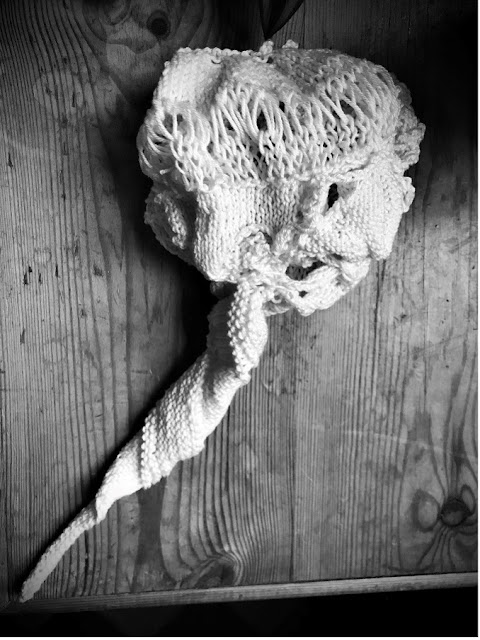
Curiosity (I, II and III)

Reading about Bridgman and reflecting on the occlusion of craft from representations of learning and teaching brought me back to arts practice to explore the sensation of making. I can’t help but think that such limited curiosity in her ability to sew, knit and crochet would have left her safe from medical intrusion. The following images relate then to my ‘thinking knitting’ akin to generative writing or in art terms perhaps Paul Klee’s ‘taking a line for a walk’. There is no sense to these knitted pieces and no utility beyond their role in enabling me to think about craft processes and the relationship between materials and the senses. They sit between a crafted homage and a knitted lament; a means of processing the dehumanising and shocking appearance of the cast of Laura Bridgman’s brain amongst her handmade doll’s clothes and delicate threads. 


This black and white photograph shows a small knitted piece made on hatpins from metal yarn. The image is edited and silver in tone and the work is displayed on the worn surface of an old upholstered chair. The roll of metal yarn is visible at the left-hand corner of the image.
  Curiosity I (metal thread on a hatpin in a domestic setting)


cream knitted piece still on two knitting needles displayed with a small ball of wool. The knitted piece is displayed on spoon hooks on a vertical piece of drift wood that also shows a yarn wrapped shell also obscured by the knitted piece.
Curiosity II (cotton yarn, driftwood bought object and shell) 


cream knitted piece, bunched abstract knitting formed in the shape of a cerebrum, cerebellum and brainstem displayed diagonally top left to bottom right on a knotted wooden surface.
Curiosity III (knitted brain bonnet, cotton yarn on wooden display chest)


This work is a development of work presented as part of the Disability Futurity Seminar Series for the Centre for Culture and Disability Studies. A recording is available here.


Claire Penketh is Associate Professor and Subject Lead for Disability Studies at Liverpool Hope University. She is a core member of the Centre for Culture and Disability Studies and member of the National Society for Education in Art and Design. She is author of A Clumsy Encounter: Dyspraxia and Drawing (Penketh, 2011) and Co-editor of Disability, Avoidance and the Academy with her colleague Professor David Bolt (Bolt and Penketh, 2016).

____________________________________________

References:
Bolt, D. (2014) The Metanarrative of Blindness – A Re-reading of Twentieth Century Anglophone Writing Ann Arbor: Michigan Press. 
French, K. (2004) Perkins School for the Blind The Campus History Series Charleston South Carolina: Arcadia Publishing.
Donaldson, H (1890) Anatomical Observations on the Brain and Several Sense-Organs of the Blind Deaf-Mute Laura Dewey Bridgman [https://archive.org/details/anatomicalobserv00dona/page/20/mode/2up?view=theatre accessed 10.10.2021]
Gitter, E. (2001) The Imprisoned Guest: Samuel Howe and Laura Bridgman, the Original Deaf-Blind Girl Farrar, Strauss and Giroux.
Macdonald, S. (1970) The History and Philosophy of Art Education University of London Press.
Royden, M.W. (1991) Pioneers and Perseverence – A History of the Royal School for the Blind, Liverpool 1791 – 1991 UK: Countyvise Ltd.


Recommended citation:

Claire Penketh (2021): Craft and Curiosity: A Dedication to Laura Bridgman. In: Public Disablity History 6 (2021) 10. 


September 13, 2021

Inside the History of Learning Disability

 By Owen Barden


A pencil portrait of Antonia Grandoni taken from Dr Ireland's book. She is in three-quarter profile, her head is bald, and she is wearing a black and white stripy shirt like a prison uniform.

Inside the History of Learning Disability was a 2018-2020 participatory project on the history of learning disability. The project focused on two points in time, the mid-19th Century and the present day. It thus spanned the history of institutionalisation. Although participatory methods are becoming more common in inclusive research, and in learning disability research particularly, it is – as far as we can tell – unique in using this approach with digital archive material. “We” are two teams of researchers who worked on the project. One team was based at The Brain Charity and Liverpool Hope University, in Liverpool. The other team came from the Teaching and Research Advisory Committee (TRAC) at the University of South Wales. The teams were made up of people with learning disabilities, their families and advocates, and academics. One academic worked with the Liverpool team and one with the TRAC team. We used material from a digital archive called the UK Medical Heritage Library to examine the history of institutionalisation of people labelled with learning disabilities. We focused on the life history of one person who was written about in a book in the archive. She was called Antonia Grandoni, and lived in Milan, Italy between 1830 and 1872. She spent a lot of her life in an institution because she was diagnosed as a ‘microcephalic idiot’ (microcephaly means having an exceptionally small head). We used creative methods as well as talking a lot about what we found in order to express what we felt about Antonia, her life, and the way she was treated. This helped us make sense of our own experiences of learning disability, and to learn about each other’s experiences. One of us summed this up very neatly: bringing the past into the future.

This project is important because people with learning disabilities have not often been able to do research about the history of learning disability. They have been excluded from much research, including the historical kind. Historical research has tended to be done by historians and other academics like sociologists. Research about learning disability has tended to be done by doctors and other people in the medical professions, like psychologists. Academic research is not generally noted as being accessible to people with learning disabilities. Although there have been some recent moves to integrate history into critical disability research – perhaps most notably in relation to this project through the work of the Social History of Learning Disability research group at the Open University – such research remains relatively scarce. This means that people with learning disabilities are often excluded from learning disability history research in three ways beyond not being regarded as its audience. Firstly, because they are not involved in producing research, they are excluded from writing about history. Their stories are not valued or listened to. Secondly, prejudice going back centuries means that disabled people – especially those we would now call people with learning disabilities – are often absent from official historical records. They are simply missed out because other people thought they weren’t important. Thirdly, archives tend to be difficult to access. There are usually many barriers. For example, many historical records are still only available in their original physical form, on paper. This means travelling to where they are kept if researchers want to see them, which can be difficult. Rules about confidentiality can also prevent access to things like hospital and asylum patient records. The old-fashioned language and handwriting can make historical material difficult to understand. Archivists and other guardians of historical materials can also be very protective of them. This is understandable, because they can often be sensitive, rare and fragile, but it does present a barrier to accessing the material. However, the recent trend towards digitising archive materials is helping to remove some of these barriers – although the UKHML is not very accessible to most people. 

The UKHML a huge collection of over 66,000 19th Century history-of-medicine texts. It has full colour images, pdf downloads, and Optical Character Recognition of the full text of all the publications it contains. It is a very important and useful resource. However, there are barriers to access to many people. Firstly, the sheer number of available texts is potentially overwhelming. Secondly, it has been set up with medical historians in mind, and is organised accordingly. For instance, when entering the archive you are invited to search either by Body Parts or Medical Conditions. Thirdly, because of the nature of the material much of the language is both old fashioned and very technical. Using modern search terms such as “learning disability” does not yield very helpful results. It is better to use the old diagnostic labels like “idiot” or “imbecile”, but even after extensive filtering a researcher is still faced with thousands of texts to choose from.  As an academic, I initially worked alone to find and select a text. The book chosen was On Idiocy and Imbecility, published by Dr William Ireland in 1877. The book contains Antonia Grandoni’s case history.  There is a descriptive account, two pencil portraits, and tables of her anatomical measurements. The history has been pieced together from the reports of doctors from Milan, where she lived with her family before being institutionalised in a hospital for an undisclosed period up until her death in 1872, at the age of 42. Various elements of her case history made it ripe for analysis and so it was chosen for the second, participatory step, which would aim to rediscover and re-interpret Antonia’s story for the present day.


A pencil portrait of Antonia Grandoni taken from Dr Ireland's book. She is in three-quarter profile, her head is bald, and she is wearing a black and white stripy shirt like a prison uniform.


The Liverpool team and the TRAC team then each ran a series of four two-hour participatory workshops. The aim of these workshops was to analyse Antonia’s story, with a view to understanding attitudes towards learning disability in her own lifetime, and to relate her life to the lived experience of learning disability today. In the early workshops, the teams focused on collectively analysing and interpreting Antonia’s case history. After analysing Antonia’s story, we moved to more creative methods in order to respond to her story and make connections to the lived experience of disability today. Both teams were facilitated in this by graphic illustrators. A full account of the methodology can be found here.


The Brain Charity research team sat around a table analysing Antonia's story and portraits. Some people are talking and some are writing.

Our key findings were that although people talk about inclusion, and think they are more inclusive these days, many of Antonia’s experiences seem very similar to what people labelled with learning disabilities often encounter today. These include discrimination, segregation and dehumanisation. For example, despite being described as ‘fond of learning amorous poetry’ and having ‘erotic tendencies’ Antonia was seemingly denied any kind of romantic relationship, an experience that resonated with many older learning-disabled team members. Despite this, and some of the harrowing stories that were told (including experiences of sexual abuse, forced medication and sexual assault) another important finding was that we very much enjoyed doing the research. As well as finding out about the history, we learned new skills, some of us grew in confidence, and we also made new friends. After the main workshop series was complete, we held Zoom meetings to explore how the project had affected the people involved.  They were asked to give one word which summed up their experience of the project. The words they gave included: Enlightening, Powerful, Very Interesting, Truthful, Inspiring, Joyful, Fascinating, Fun, Challenging, Transformative, Amazing, & Very Moving. 

People felt privileged to have the opportunity to tell their own stories, be listened to and understood, and to listen to others’ stories. Many people spoke about how they had grown in confidence and were more willing to try new things and to express their ideas and opinions. For example, one person said he was terrified before the first workshop and almost went home without getting out of the taxi, but now thinks it’s one of the best things he’s ever done. Several TRAC researchers felt able to participate in another study about the impact of Covid-19. Others spoke about how the research methods used tapped into creativity they didn’t know they possessed. We all – academics, learning-disabled researchers, family members and volunteers - learnt a lot about each other and the lived experience of learning disabilities today.


A illustration of the TRAC team's interpretation of the dehumanisation of Antonia. A poster showing Antonia having her head shaved, with a rat underneath. Both teams thought she was treated like a 'lab rat' and had little choice in her life.
A illustration of the TRAC team's interpretation of the dehumanisation of Antonia. A poster showing Antonia having her head shaved, with a rat underneath. Both teams thought she was treated like a 'lab rat' and had little choice in her life.

The participative research project had substantial public impact through public engagement activities including building a website and showcasing our work at the national Being Human Festival in November 2019. Attendees who completed the feedback questionnaire unanimously rated the experience as either Good or Excellent, because it helped them think about both learning disability history and research methods in new ways. Our event was featured in the organiser's Twitter Festival Highlights and blog. The project was also used by Jisc at DCDC19 - a conference co-hosted by The National Archives, Research Libraries UK and Jisc, and aimed at professionals and academics in the library, archive and heritage sectors - as an exemplar by for how archive material can be made relevant to new, unanticipated and under-represented audiences.  So the project was not just about being inclusive for its own sake – it went a long way to meet the criteria for ‘good’ research by eliciting insider knowledge that would otherwise have remained untapped, having substantial public impact, and transforming the lives of the people involved.

* Funding: This work was funded by British Academy / JISC Digital Research in the Humanities Grant DRH18\180095

Owen Barden (bardeno@hope.ac.uk) is Associate Professor in Disability Studies at Liverpool Hope University.  He is a core member of the Centre for Culture and Disability Studies, and Comments Editor for the Journal of Literary and Cultural Disability Studies. He has contributed chapters to the Cultural History of Disability in the Modern Age (Mitchell & Snyder, 2020), as well as Disability, Avoidance in the Academy (Bolt & Penketh, 2016) and Changing Social Attitudes (Bolt, 2014)in addition to an extensive range of journal publications.

_____________________


Recommended citation:

Owen Barden (2021): Inside the History of Learning Disability. In: Public Disability History 6 (2021) 8.